

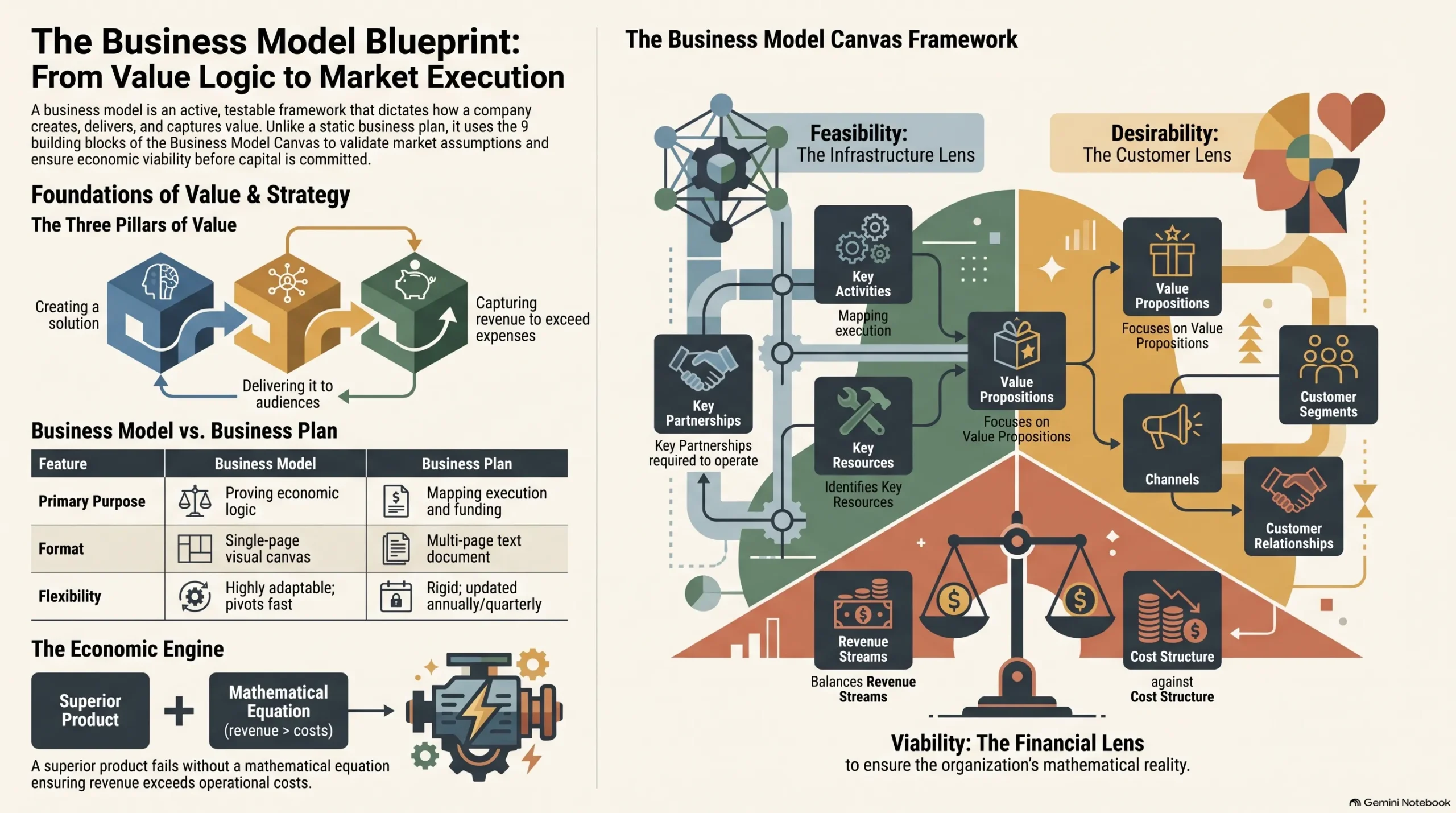
A business model is the operational and financial blueprint that dictates exactly how a company creates, delivers, and captures value while generating enough revenue to exceed its expenses. Unlike a static business plan used for funding, it serves as an actively testable, one-page framework to validate customer segments, value propositions, and cost structures against real market behavior before committing capital. This mathematical reality ensures a startup can move from a theoretical idea to a sustainable, profitable entity.
Introduction
A superior product paired with a flawed financial structure will always fail. A business model is the exact blueprint of how your organization creates, delivers, and captures value. It defines your target audience, the specific problem you solve for them, how you will reach them, and the mathematical reality of how you will make more money than you spend to keep the operation running.
Founders often confuse building a product with building a company. Code, design, and manufacturing are components of an offering, but they do not guarantee market survival. To move from a theoretical idea to a profitable entity, you need a documented strategy that aligns your cost structure with your revenue streams. This requires identifying your exact customer segments, defining a clear value proposition, and testing your assumptions against market realities before capital runs out.
Business Model Foundations: The Economic Logic Behind Market SurvivalEnglish Source Text“A business model is the story that explains how an enterprise works. It answers Peter Drucker’s age-old questions: Who is the customer? And what does the customer value? It also answers the fundamental questions every manager must ask: How do we make money in this business? What is the underlying economic logic that explains how we can deliver value to customers at an appropriate cost?When business models fail, it is usually because they fail either the narrative test—the story about how the organization creates value doesn’t make sense—or the numbers test—the revenue structure cannot consistently support the cost of operations.”
-
Source: Harvard Business Review (HBR)
-
Active URL: Harvard Business Review – Why Business Models Matter
What is a Business Model? (Core Concept)
A business model is the exact mechanism a company uses to create, deliver, and capture value. It defines the specific product or service you offer, the exact audience that needs it, the channels used to reach them, and the mathematical equation ensuring revenue exceeds operational costs.
The concept breaks down into three actionable pillars. First, creating value requires identifying a distinct customer problem and building a solution that addresses it directly. Second, delivering value involves the logistics, marketing channels, and customer relationships necessary to put that solution into the user’s hands. Finally, capturing value dictates the pricing strategy and cost structure that allow the organization to retain a portion of the generated wealth as profit.
A good business model answers Peter Drucker’s age-old questions: Who is the customer? And what does the customer value? It also answers the fundamental questions every manager must ask: How do we make money in this business? What is the underlying economic logic that explains how we can deliver value to customers at an appropriate cost?
Source: Harvard Business Review
Business Model vs. Business Plan: The Critical Difference
A business model is the operational logic of how an organization works, whereas a business plan is a static document detailing the step-by-step timeline, team hierarchy, and financial projections required to execute that logic. You must design and validate the model first to prove the core concept is viable before drafting a plan to secure funding or guide daily operations.
Founders frequently waste weeks writing 40-page plans for unproven ideas. A working model fits on a single sheet of paper and changes rapidly based on market feedback, while a plan assumes the model is already finalized and outlines how to scale it over the next 1 to 5 years.
| Feature | Business Model | Business Plan |
|---|---|---|
| Primary Purpose | Proving the core economic logic and value delivery | Mapping execution, timelines, and securing investment |
| Format | Single-page canvas or visual diagram | Multi-page structured text document |
| Flexibility | Highly adaptable; pivots based on immediate market testing | Rigid; typically updated annually or quarterly |
| Key Audience | Founders, product teams, early market testers | Banks, external investors, board members |
The 9 Building Blocks: The Business Model Canvas Explained
The Business Model Canvas, developed by Alexander Osterwalder, is a single-page visual framework that replaces traditional, dense business plans by mapping out the nine essential building blocks of a company. It forces founders to distill complex operations into a clear, testable format, prioritizing immediate market feedback over untested assumptions written in a 50-page document.
This framework is divided into three distinct categories: desirability, feasibility, and viability. By segmenting operations this way, you can quickly identify gaps in your strategy before committing capital to a flawed idea.
Desirability (Value Prop, Customer Segments, Channels, Relationships)
Desirability focuses on the right side of the canvas, proving that a market actually wants your product. It starts with the value proposition, defining the exact problem you solve or the distinct benefit you provide. Customer segments identify the specific groups of people or organizations paying for that value. Channels determine the physical or digital avenues used to deliver the product to the customer, while customer relationships dictate how you acquire, retain, and grow your user base.
Feasibility (Key Resources, Activities, Partnerships)
Feasibility occupies the left side of the canvas, mapping the operational infrastructure required to deliver your value proposition. Key activities are the most important actions your company must take to operate successfully, such as software development, manufacturing, or supply chain management. Key resources include the physical, intellectual, human, or financial assets necessary to sustain the business. Key partnerships identify the suppliers, alliances, or joint ventures needed to optimize operations, reduce risk, or acquire resources you cannot generate internally.
Viability (Revenue Streams & Cost Structure)
Viability sits at the bottom of the canvas, representing the mathematical reality of your organization. Revenue streams define how the company extracts cash from each customer segment, whether through asset sales, usage fees, subscriptions, or licensing. Cost structure maps all expenses incurred to operate the business, categorized mainly into fixed and variable costs. If the revenue generated does not clearly and consistently exceed the cost structure, the core logic fails.
12 Proven Business Model Examples (With Real-World Successes)
The most profitable organizations do not rely on isolated products; they execute repeatable models that mathematically dictate how they generate revenue and scale. Analyzing proven frameworks allows you to select the specific economic engine that aligns with your cost structure, user behavior, and market constraints. Rather than inventing a monetization strategy from scratch, you can apply these established structures to your own operations.
A lot of startups and established companies are trying to compete on superior technology, products, services and price. They are stuck in a rat race. Yet, the world’s most successful companies compete on superior business models. These business models build on patterns, i.e. repeatable configurations of different business model building blocks to strengthen an organization’s overall business model.
Source: Strategyzer
| Model Category | Revenue Logic | Primary Challenge |
|---|---|---|
| Subscription & Freemium | Recurring revenue over time | Customer churn and acquisition cost |
| Marketplace / Platform | Transaction fees or commissions | Building simultaneous supply and demand |
| Razor & Blade | High margins on required consumables | Creating strong ecosystem lock-in |
| Emerging (AI & Circular) | Token usage or secondary sales | High infrastructure or reverse logistics costs |
The Subscription & Freemium Models (e.g., Spotify, Slack)
Subscription and freemium structures operate on the mechanics of recurring revenue and low marginal costs. You provide continuous access to a service for a regular fee, prioritizing customer lifetime value over single-transaction profit. The freemium variation offers a basic version of the product at no cost to remove the barrier to entry, functioning as an acquisition channel to build a massive user base. You then convert a specific percentage of those users to a paid tier by gating advanced features or usage limits behind a paywall. Slack, for instance, allows teams to communicate for free but restricts message history, forcing active teams to upgrade once the software becomes embedded in their daily workflow.
The Marketplace / Platform Model (e.g., Airbnb, Uber)
Marketplace models generate revenue by facilitating transactions between two distinct groups, usually buyers and sellers, without owning the underlying inventory. Your primary asset is the network itself, and success depends on solving the supply and demand problem simultaneously: attracting enough suppliers to bring in buyers, and enough buyers to keep suppliers engaged. You capture value by taking a percentage fee on every exchange. Network effects protect these structures; as more people use Airbnb or Uber, the platform becomes exponentially more valuable to both sides, creating a massive barrier to entry for new competitors.
The Razor & Blade Model (e.g., Gillette, Apple Ecosystem)
The razor and blade model dictates selling a primary product at a low margin or a loss, then generating high-margin, recurring revenue from the consumable items required to use that product. You intentionally lock the customer into your specific ecosystem. Gillette sells the handle cheaply but charges a premium for the replacement blades. Apple applies a digital variation of this strategy by selling hardware like the iPhone, then capturing high margins on software, subscriptions, and services processed through its App Store, effectively trapping users in a highly profitable, closed loop.
Emerging Models: Circular Economy & AI-Driven
Emerging models restructure traditional supply chains and computing costs to match modern market realities. The circular economy model, utilized by companies like Patagonia, eliminates waste by designing products for continuous reuse, repair, and resale, turning sustainability into a direct financial advantage through secondary market sales and extreme customer loyalty. AI-driven models replace human service labor with programmatic generation, charging customers based on API usage tokens or compute time. Companies like OpenAI scale by providing underlying infrastructure to other businesses, shifting the cost structure entirely to server processing power rather than traditional manufacturing or manual service hours.
How to Create and Validate Your Business Model in 5 Steps
| Validation Step | Core Objective | Key Action Items | Real-World Example |
|---|---|---|---|
| Step 1: Identify the Problem & Value Proposition | Confirm that a genuine, painful market demand actually exists before building a solution. | Isolate a single friction point that users actively spend time or money trying to solve; analyze market search intent. | Analyzing search traffic and informational intent around loan calculators before launching a financial services brand. |
| Step 2: Map Assumptions on the Canvas | Convert business ideas into a visual map of testable hypotheses. | Document precise assumptions regarding customer profiles, marketing channels, and operational cost structures. | Assuming a digital directory platform will generate primary traffic through organic search and specialized URL architecture. |
| Step 3: Test and Validate (The Lean Approach) | Gather real-world behavioral and payment data with the absolute minimum resources. | Build a bare-bones Minimum Viable Product (MVP) that eliminates non-essential features and technical bloat to test core functions. | Deploying a simple directory tool built on pure HTML, CSS, and Vanilla JavaScript instead of a complex React application. |
Moving from a theoretical idea to a validated structure requires testing your core economic assumptions against real user behavior before building the final product. You must document exactly how you intend to acquire users, the price they are willing to pay, and the minimum infrastructure required to deliver that value, then measure those guesses directly in the market.
Step 1: Identify the Problem and Your Value Proposition
Start by isolating a single, painful problem your target audience actively spends time or money trying to solve. Your value proposition is the exact mechanism that removes this friction. If you are conceptualizing a financial services brand, your initial step is analyzing whether you can capture informational search intent around specific financial products or loan calculations. If users are not actively seeking solutions to the problem, your value proposition lacks a foundation. You must confirm the problem exists before designing the solution.
Step 2: Map Your Assumptions on the Canvas
Treat every block on your initial canvas as an untested hypothesis rather than a proven fact. Write down your exact guesses for the customer profile, the acquisition channels, and the operating costs. If you plan to build a digital directory platform, a core assumption might be that your primary acquisition channel will be organic search driven by a highly structured system ontology and URL architecture. These remain assumptions until market data proves they generate traffic and revenue.
Step 3: Test and Validate (The Lean Approach)
Build the smallest possible version of your solution to test whether customers will actually engage and pay. This minimum viable product should eliminate all non-essential features and technical bloat. Instead of spending months developing a complex application with heavy framework overhead like React, deploy a standalone tool using pure HTML, CSS, and Vanilla JavaScript to test the core function quickly. If users refuse a simple, functional version of your product, they will not pay for a polished version. Measure their interaction, adjust your canvas based on the data, and iterate.
The lean startup methodology tells founders to start searching for a business model by testing hypotheses. Instead of writing an intricate business plan, founders summarize their hypotheses in a framework called a business model canvas. Essentially, this is how they search for a repeatable and scalable business model.
Source: Harvard Business Review
Why Business Models Fail: Lessons from the Real World
Business models fail when the cost of acquiring a customer permanently exceeds the lifetime value that customer generates. Many founders build complex features without calculating the exact marketing spend required to get someone to pay for those features. If your organization spends $50 in advertising to acquire a user who pays $10 a month and cancels after three months, the financial structure collapses regardless of the product quality.
Another common trap is misjudging the target market’s willingness to pay. Assuming users will pay a premium simply because a tool solves a problem ignores the context of existing alternatives and ingrained user habits. You cannot scale a company if the operational costs require a high price point, but the market views the solution as a cheap commodity.
Running out of cash—tied to the inability to secure financing or generate revenue—is the top reason startups fail, cited by 38% of founders in post-mortems. This is a direct symptom of a business model that cannot balance customer acquisition costs with lifetime value.
Source: CB Insights
Case Study: When Great Tech Meets a Bad Model
MoviePass went bankrupt because it sold a service for less than the direct cost of delivering it. The company offered a $9.95 monthly subscription allowing users to watch one movie per day in theaters. However, MoviePass paid the theaters the full retail price for every single ticket its users booked. The more customers used the product, the faster the company lost money.
The app functioned perfectly and consumer demand was massive, but the mathematical foundation was upside down. The founders assumed they could achieve massive scale quickly and then force theater chains to negotiate discounted ticket prices. The major theaters refused. Because MoviePass could not control its variable supply costs or introduce a sustainable revenue stream, the cost structure guaranteed the destruction of the company.
Business Model Innovation: Future-Proofing Your Company
Business model innovation is the deliberate process of altering how your company creates, delivers, or captures value to defend against market disruption and open new revenue streams. Established organizations must launch secondary models alongside their core operations to test new pricing structures, delivery channels, or customer segments without destroying their existing cash flow.
Instead of inventing entirely new concepts, successful pivots rely on adapting existing patterns to new industries. The Business Model Navigator framework identifies 55 distinct patterns that account for the vast majority of successful business model innovations. Applying these patterns allows you to systemize the transition. A heavy machinery manufacturer, for instance, can shift from direct equipment sales to a pay-per-use structure, effectively applying the same pattern pioneered by the commercial aviation industry.
| Pattern Name | How It Captures Value | Real-World Application |
|---|---|---|
| Add-On | The core offering is priced low; high margins are made on optional extras. | Budget airlines charging for baggage and seat selection. |
| Lock-In | Customers incur high technical or financial costs to switch to a competitor. | Proprietary data ecosystems and closed hardware environments. |
| White Label | Producing infrastructure or goods sold under another company’s brand identity. | Financial technology companies providing backend payment processing. |
To prevent a new model from cannibalizing core revenue, execute the transition through an isolated spin-off or a tightly controlled test market. The innovation unit needs distinct performance metrics separate from the main business. If you evaluate a nascent subscription product using the same quarterly revenue expectations as a mature retail operation, management will terminate the project long before it achieves product-market fit.
Conclusion & Next Steps
Your business model dictates your market survival. Stop writing lengthy plans for unproven ideas and start mapping your operational assumptions on a single page. The effort spent debating financial projections for a product that has not been tested is better spent validating your value proposition against actual user behavior and their direct willingness to pay.
The shift from an abstract idea to a functioning company requires immediate documentation and strict measurement. Document your target customer segments, define your exact revenue streams, and list your baseline cost structure right now to identify any obvious mathematical flaws in your strategy.
Download our free Business Model Canvas template to organize your initial hypotheses and begin testing your economic engine in the real world today.
FAQs (Frequently Asked Questions)
What are the 4 main types of business models?
The four primary categories dictate the direction of the transaction between buyers and sellers: Business-to-Business (B2B), Business-to-Consumer (B2C), Consumer-to-Business (C2B), and Consumer-to-Consumer (C2C).
| Type | Definition | Example |
|---|---|---|
| B2B | A company sells products or services directly to another company. | Enterprise software, wholesale manufacturing |
| B2C | A company sells directly to the individual end-user. | Retail clothing, grocery stores |
| C2B | Individuals sell their services or data to an organization. | Independent contractors, reverse auctions |
| C2C | Individuals trade directly with one another, typically facilitated by a third-party platform. | Used goods marketplaces, peer-to-peer lending |
How do you write a business model?
You write it by visually mapping your operational and financial assumptions across nine specific building blocks, rather than drafting a long text document. Start by defining your exact target audience and the specific problem you solve for them. Next, outline your delivery channels, relationship management tactics, required resources, daily activities, and necessary partnerships. Finally, detail your cost structure and revenue streams. Once these hypotheses are recorded, you immediately build a small test version of the product to see if users will actually pay for it.
What is the best business model for a startup?
The correct structure depends entirely on your initial capital, market size, and product format, but the subscription or software-as-a-service approach is statistically the most robust for new companies. It generates recurring, predictable cash flow, which drastically reduces the risk of running out of money between product launches. By securing regular monthly or annual payments, founders can calculate customer lifetime value with high accuracy and scale their marketing spend safely.
Is a franchise a business model?
Yes, franchising is a highly specific model designed to execute rapid geographic expansion while shifting the financial risk of opening physical locations to third parties. The parent company creates value by developing a proven operational system, supply chain, and recognized brand identity. It captures value by licensing the rights to use that exact system to independent operators in exchange for an upfront initial fee and a recurring percentage of their gross sales.


