

Event content marketing generates verifiable pipeline revenue and ticket sales by replacing generic promotional blasts with targeted, educational media distributed across a structured three-phase timeline. By aligning pre-event teaser videos, live social coverage on the show floor, and automated post-event nurture sequences, organizations capture search intent and transform temporary attendee interest into high-converting B2B leads. Operating this three-stage content lifecycle ensures that recorded event assets continue driving qualified pipeline long after the physical event closes.
What is Event Content Marketing?
“According to Content Marketing Institute’s B2B Research, in-person events and webinars consistently rank among the highest-performing content formats for securing and converting B2B leads.”
Event content marketing is the strategic creation and distribution of media designed to drive event registrations, engage live attendees, and convert post-event leads into pipeline revenue. It replaces generic promotional blasts with educational, value-driven assets that prove the worth of your event long before a ticket is purchased. By treating the event as a central hub for content production, field marketing and agency teams can capture attention organically rather than relying entirely on paid advertising budgets.
Defining the Event Content Lifecycle
The event content lifecycle organizes your strategy into three distinct operational phases: pre-event, during-event, and post-event. Rather than viewing an event as a single date on a calendar, this framework stretches the event’s lifespan. You build anticipation early, maximize attendee engagement on the ground, and use the recorded material to fuel your marketing channels for the rest of the year.
| Lifecycle Phase | Primary Goal | Core Focus |
|---|---|---|
| Pre-Event | Demand Generation | Publishing teaser content, speaker interviews, and high-converting landing pages to drive ticket sales. |
| During-Event | Live Engagement | Fostering user-generated content, sharing real-time updates, and capturing micro-video moments from the show floor. |
| Post-Event | Repurposing and Nurturing | Slicing keynotes into short-form assets, sending surveys, and passing marketing qualified leads to sales. |
Structuring your approach this way ensures you are not scrambling to figure out what to post the week of the event. It aligns your content directly with the psychological stages of your target audience, moving them from unaware to registered, to actively engaged, and finally to brand advocates.
In-person events and webinars consistently rank among the top content types producing the best results for securing and converting leads in the B2B space, making a documented strategy essential for maximizing the return on these heavy investments.
Source: Content Marketing Institute
Phase 1: Pre-Event Content Strategies (Driving FOMO & Registrations)
Pre-event content must create an undeniable sense of missing out while explicitly demonstrating the professional or personal value of attending. Do not wait until the week before your event to start marketing. You need to map out a multi-channel campaign that begins months in advance, gradually increasing in frequency as the date approaches. This phase is about capturing search intent, leveraging the audiences of your partners, and converting that traffic through highly optimized digital real estate.
Anatomy of a High-Converting Event Landing Page
Your event landing page is the single most critical asset in your pre-event strategy, serving as the final conversion point for all your marketing efforts. A high-converting page must immediately articulate the value proposition, specifically answering what the attendee will learn or experience. It needs a clear, prominent breakdown of the agenda, removing any ambiguity about the schedule. Highlighting speaker authority with professional headshots, brief bios, and their specific session topics builds trust. Finally, incorporate urgency triggers, such as countdown timers for early-bird pricing expirations or limited capacity warnings, to compel immediate action rather than delayed consideration.
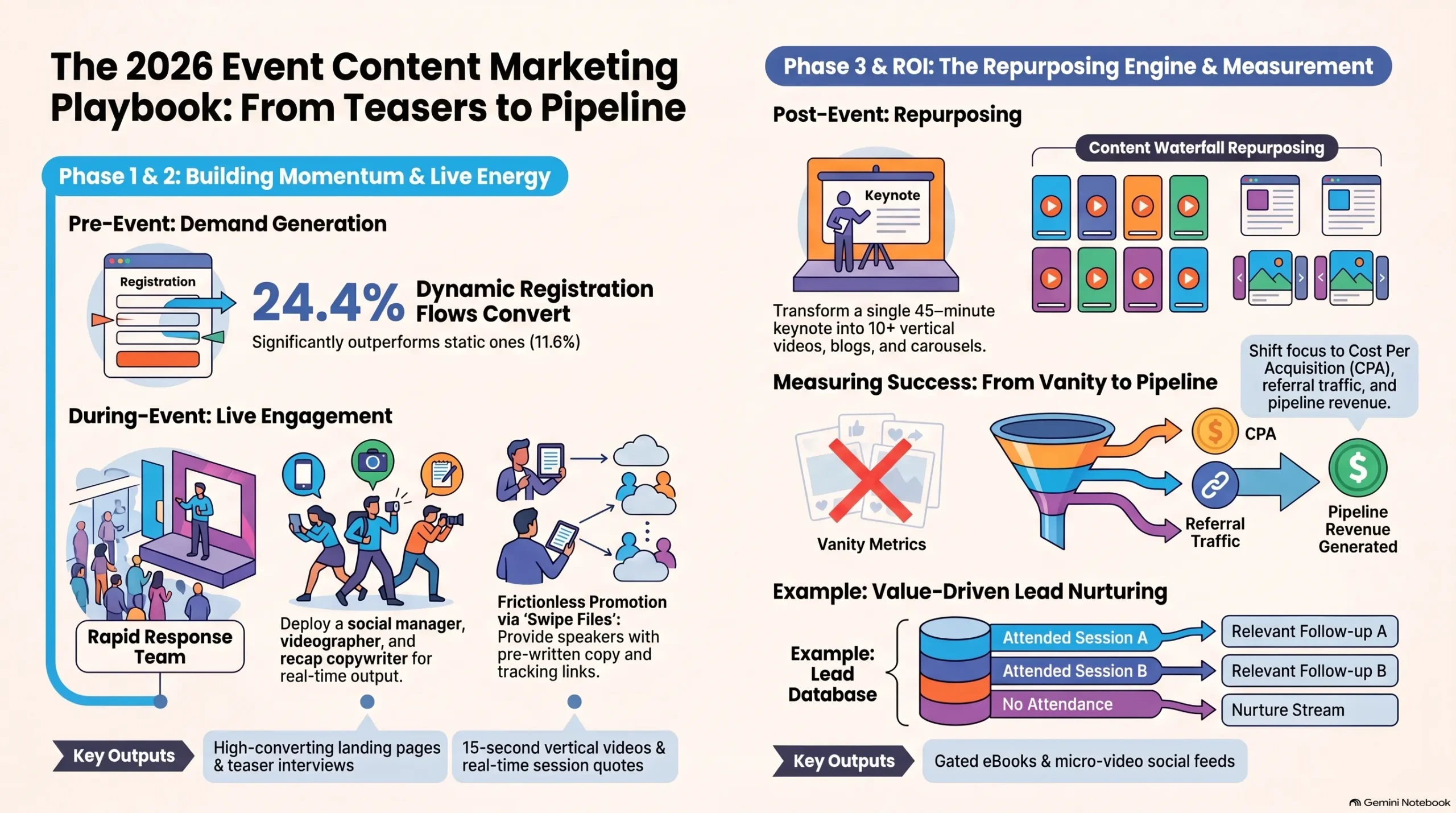
According to Bizzabo’s 2026 State of Events Benchmark Report, dynamic registration flows convert at 24.4%, compared with just 11.6% for static flows, a gap that shows how much registration design itself shapes event outcomes.
Source: Bizzabo
The structure of the page dictates user behavior. Avoid cluttered navigation menus that allow users to click away from the registration path. Keep the form fields to the absolute minimum required to process the ticket or capture the lead. Every additional field reduces the conversion rate. Ensure the page loads quickly and is fully responsive, as a significant portion of ticket purchases occur on mobile devices.
Creating Speaker and Sponsor “Swipe Files”
Providing speakers and sponsors with “swipe files” is a scalable tactic to tap into their established audiences and drive targeted referral traffic. A swipe file is a packaged folder containing pre-written social media copy, varied for different platforms like LinkedIn and X (formerly Twitter). It should also include custom graphics tailored to the speaker or sponsor, featuring their headshot, session title, and the event branding. The goal is to make promoting your event frictionless for them; they should be able to copy, paste, and post in under a minute.
To measure the effectiveness of this strategy, you must assign unique tracking links to each speaker and sponsor. This allows you to attribute registrations directly to their promotional efforts.
| Swipe File Asset | Purpose | Best Practice |
|---|---|---|
| Pre-written Social Copy | Reduces friction for the speaker/sponsor to post. | Provide 3-5 variations, ranging from short teasers to longer, value-driven posts. |
| Custom Graphics | Increases visual engagement and reinforces event branding. | Create correctly sized images for LinkedIn, Instagram Stories, and X. |
| Unique Tracking Link (UTM) | Measures the ROI of their promotional efforts. | Use a clean, branded short link rather than a long, complex URL. |
Teaser Content: Blogs, Podcasts, and Video Interviews
Teaser content builds sustained anticipation and captures organic search traffic by answering the specific questions your target audience is asking long before the event dates. You should produce short video interviews with your keynote speakers, extracting one highly actionable piece of advice they will expand upon during their session. Publish blog posts that dive into the core themes of the event, optimizing them for industry-specific keywords. If you host a podcast, dedicate a mini-series to topics adjacent to the event’s agenda, featuring sponsors or past attendees.
Data: For festivals, 15% of tickets sell during the first week, and 24% during the last week. That leaves 61% of tickets selling during tiered ticket-release stages in between. To capture all types of ticket buyers at such events, you’ll want to spread awareness and inspire conversion at each stage of ticketing.
Source: Eventbrite
Distribute these assets across your owned channels and use them as the fuel for your email marketing nurture sequences. Instead of sending emails that simply say “buy a ticket,” send the video interview with a call to action to register to hear the rest of the presentation. This educational approach builds authority and prevents audience fatigue during the long promotional cycle.
Phase 2: During-Event Content (Maximizing Live Engagement)
Live event content operations require a rapid shift from planned publishing to real-time journalistic coverage. You must capture the energy of the show floor, broadcast immediate takeaways from sessions as they happen, and make remote audiences recognize the exact value they are missing. Executing this requires a dedicated team working with strict, single-channel directives so no high-impact moment goes unrecorded or gets stuck in an approval bottleneck.
The “On-the-Ground” Content Team Strategy
Divide your on-site content staff into specialized roles focused entirely on output speed. Assign one team member exclusively to monitor sessions and publish striking quotes to LinkedIn and X within minutes of a speaker leaving the stage. Dedicate a mobile videographer to capture raw, 15-second micro-video moments, focusing on crowd reactions, quick sponsor interviews, and behind-the-scenes interactions for immediate upload to vertical video feeds. Station a copywriter in a quiet zone away from the show floor to draft daily email recaps, synthesizing the day’s top insights to send to your entire database each evening while the momentum is highest.
| Assigned Role | Core Responsibility | Primary Output |
|---|---|---|
| Social Media Manager | Live-tweeting and LinkedIn coverage | Real-time speaker quotes and thread updates |
| Mobile Videographer | Capturing visual show floor energy | 15-second vertical videos (Reels/TikToks) |
| Recap Copywriter | Synthesizing session takeaways | Daily email blasts and quick-hit blog posts |
Fostering User-Generated Content (UGC)
Engineer your physical and virtual event spaces to naturally prompt attendee content creation without requiring heavy manual oversight. Place highly visible event hashtags on every holding screen, printed badge, and stage backdrop so attendees immediately know how to tag their posts. Construct specific, well-lit physical installations that look visually striking on camera, organically encouraging people to take selfies and group shots for their own feeds.
Introduce gamification by offering tangible rewards, such as VIP seating, fast-track access, or exclusive merchandise, to the attendees who share the most creative posts on the event app or public social channels. You can also embed live polls directly into the session presentations. When results are instantly displayed on the main stage screen, you force attendees to open their devices, interact with your digital infrastructure, and actively participate in the content narrative rather than just consuming it.
Phase 3: Post-Event Content (The Repurposing Engine)
Post-event content generation transforms a single live occurrence into months of marketing assets by systematically dismantling session recordings. You stop treating the event as a finished project and start treating it as a raw data source for your marketing pipeline. The focus shifts from driving registrations to extracting value from the recorded footage and continuing the conversation with attendees who are now primed for deeper engagement.
The “Content Waterfall” Method
The Content Waterfall method dictates that no keynote or panel exists as just a single, hour-long video sitting untouched on a server. You take one 45-minute presentation and break it down sequentially into smaller, channel-specific formats. First, extract the transcript. Use this text to write three distinct blog posts, each focusing on a specific sub-topic or case study mentioned by the speaker. Next, scrub the video file to identify punchy, self-contained statements lasting under 60 seconds. Crop these into 10 vertical short-form videos for social media feeds. From those same high-impact quotes, design 5 separate LinkedIn carousels that visually break down the speaker’s data points slide by slide. Finally, bundle the transcribed insights, the live Q&A, and the presentation deck into a single gated eBook.
| Source Asset | Derivative Assets | Primary Channel |
|---|---|---|
| 1x 45-Minute Keynote Video | 10x Vertical Micro-Videos | Reels, TikTok, YouTube Shorts |
| Keynote Transcript & Data | 3x Blog Posts & 5x Carousels | Company Website, LinkedIn |
| Full Session & Audience Q&A | 1x Gated eBook | Email Nurture Sequence |
Post-Event Surveys and Lead Nurturing
Send your post-event surveys within 24 hours of the closing keynote to capture accurate qualitative feedback while the experience is fresh. Avoid sending a generic text-only thank you message. Embed the survey alongside a high-value piece of post-show content, such as the presentation slides or a summary checklist, creating a value exchange that increases survey completion rates.
Segment your attendee list based on their session attendance and polling data to trigger specific lead nurturing sequences. If an attendee watched a specific product demo track, pass them to the sales team as a Marketing Qualified Lead accompanied by a highly relevant case study document. If they only attended high-level thought leadership sessions, keep them in marketing nurture flows. Send them the repurposed blog posts and video snippets from the Content Waterfall process until their engagement behavior indicates clear buying intent.
Measuring the ROI of Your Event Content
Event content ROI is calculated by tracking the exact pipeline revenue and customer acquisition cost directly attributed to your marketing assets. You must connect content consumption to ticket sales and eventual closed-won deals rather than stopping your analysis at social media engagement. Setting up multi-touch attribution models before the promotion launches allows your team to see which specific blog post, video interview, or email sequence actually pushed a prospect to register or request a sales demo.
Moving Beyond Vanity Metrics
Stop reporting on likes, shares, and impressions as primary success indicators. These metrics do not justify your event budget to executive leadership. Shift your reporting entirely to bottom-funnel key performance indicators. You need to track referral traffic from your speaker swipe files, calculate the cost per acquisition for paid campaigns promoting your teaser videos, and measure the total pipeline generated from leads who consumed your post-event webinars or eBooks.
Assign specific tracking parameters to every piece of content you distribute across the entire event lifecycle. This data feeds directly into your CRM, giving field marketing directors a clear, quantitative view of which content formats influence purchasing decisions and which fall flat.
| Business Metric | What It Measures | How to Track It |
|---|---|---|
| Referral Traffic | Volume of visitors clicking from external content to your registration page. | UTM parameters on all speaker, sponsor, and partner links. |
| Cost Per Acquisition (CPA) | Total ad spend on content promotion divided by acquired registrations. | Ad platform pixels integrated with CRM conversion tracking. |
| Pipeline Generated | Total potential revenue from leads who engaged with event content. | CRM campaign attribution and lead scoring models. |
Practitioner Insights: Pitfalls to Avoid
The most expensive event marketing failure is operating content and event logistics in isolated silos, resulting in fragmented messaging and late promotional launches. You must align your field marketing, social, and sales teams on a single editorial calendar at least 16 weeks before the event to prevent the panicked, last-minute scramble for registrations.
Many teams mistakenly treat the physical event as the finish line, neglecting the post-event nurturing strategy until the show is already over. This oversight leaves attendees waiting weeks for recorded sessions and follow-up emails, causing their buying intent to rapidly decay. Pre-write your post-event email sequences and map out your marketing automation triggers before the doors even open.
| Common Pitfall | The Symptom | Tactical Fix |
|---|---|---|
| Promoting Too Late | High reliance on expensive paid ads and stagnant organic search registrations. | Launch the registration page and teaser interviews 16 weeks prior to the event date. |
| Siloed Content Planning | The agenda lacks search volume alignment; content teams struggle to find repurposing angles. | Require content strategists to co-approve session topics during the initial planning phase. |
| Ignoring Virtual Attendees | High drop-off rates on live streams within the first 20 minutes and zero chat participation. | Assign dedicated virtual emcees and stream exclusive digital-only content during physical breaks. |
Broadcasting a single, static wide-angle shot of the main stage to virtual attendees actively damages your brand perception. Remote participants require high-quality audio feeds piped directly from the soundboard and varied camera angles of the speakers and presentation slides. Treat your virtual broadcast like a live television production rather than a stationary security camera feed to maintain high retention rates across hybrid events.
Your Next Steps
A strategic event content lifecycle prevents empty rooms and wasted live-event investments. Implement the pre-event teaser strategies immediately, assign clear on-the-ground roles for live coverage, and execute the content waterfall method to fuel your post-event pipeline. To operationalize these phases without missing deadlines, map every asset against your promotional timeline. Download a free event content calendar template to assign owners, track production statuses, and measure the CRM impact of every deliverable.
Frequently Asked Questions
What is the difference between event marketing and event content marketing?
Event marketing encompasses the entire logistical and promotional operation of hosting an event, including venue booking, catering, and direct ticket sales. Event content marketing is a specific strategy within that operation focused solely on creating and distributing media—like blogs, videos, and podcasts—to attract attendees organically and extend the lifespan of the event’s messaging.
How far in advance should I start content marketing for a major event?
Begin publishing teaser content and launch your optimized registration page at least 16 weeks prior to the event date. This four-month runway allows search engines to index your landing pages, provides partners enough time to utilize swipe files, and prevents reliance on last-minute, high-cost paid advertising.
What are the best content formats for promoting B2B virtual events?
Short-form video interviews with keynote speakers and data-driven LinkedIn carousels drive the highest registration volume for B2B virtual events. These formats quickly prove the professional value of the session while fitting naturally into the standard business social media feed.
How do you keep attendees engaged with content after the event ends?
Send targeted follow-up sequences based on the specific tracks or sessions an attendee watched. Distribute gated eBooks built from keynote transcripts, share vertical micro-videos of top quotes, and immediately send qualitative surveys paired with direct access to the presentation slides.
How can I repurpose event content if I have a small marketing team?
Focus exclusively on the content waterfall method applied to your single highest-performing keynote. Extract the raw transcript using automated software, use it to draft three core blog posts, and pull five 60-second video clips from the recording. This approach maximizes output from one core asset without requiring a large production crew.


