

Event management is the application of project management operations to execute large-scale gatherings such as corporate conferences, trade shows, and hybrid broadcasts. It involves securing venue logistics, directing on-site vendors, managing budgets, and resolving real-time technical crises on the event day. While event planning establishes the creative vision and themes, event management strictly governs the physical setup, staff coordination, and operational delivery.
Defining Event Management: The Logistics Behind the Experience
Event management is the direct application of project management methodologies to the creation, execution, and wrap-up of professional or personal events. For a guest, a successful corporate event or product launch feels effortless—a fluid sequence of engaging speakers, well-timed catering, and flawless audio-visual transitions. Behind that polished exterior, an event manager is orchestrating a strict operational matrix. This involves active vendor management, real-time risk mitigation, strict budget allocation, and the enforcement of complex logistical timelines.
Defining Event Management: The Logistics Behind the ExperienceEnglish Source Text“Managing a high-profile event is often more pressure-inducing than managing a complex project. With events, there is a set date around which participants plan their schedules: thus, the event manager cannot miss any deadlines. In short, schedule overruns are never an option.A capable manager ensures that every technical and physical element operates correctly on the day of the gathering. They coordinate loading dock schedules, verify that audio-visual equipment functions as intended, and guarantee that catering staff have access to necessary facilities to minimize attendee friction.
- Source: Project Management Institute (PMI)
This guide breaks down the exact processes, necessary skills, and daily realities of operating in this sector. You will see the distinct operational differences between planning an event and actively managing one. We detail the specific workflows for venue sourcing, how to structure your operations, and the ways modern professionals integrate event technology to handle hybrid events and deliver clear post-event ROI.
What is Event Management?
Event management is the direct application of project management methodologies to the creation, execution, and post-event analysis of gatherings ranging from corporate conferences to hybrid trade shows. Professionals in this discipline govern all operational logistics, which includes securing event technology, managing vendor contracts, enforcing health and safety protocols, and monitoring budget allocation. Because an event happens on a fixed date, this role demands strict schedule adherence and immediate crisis resolution.
The Project Management Institute (PMI) clarifies the operational constraints of this profession:
“Managing a high-profile event is often more pressure-inducing that managing a complex project. With events, there is a set date around which participants plan their schedules: Thus, the event’s manager cannot miss any deadlines. In short, schedule overruns are never an option.”
A capable manager ensures that every technical and physical element operates correctly on the day of the gathering. They coordinate the loading dock schedules, verify that the audio-visual equipment functions as intended, and guarantee that catering staff have access to necessary facilities. Their objective is to minimize friction and prevent technical or logistical failures before attendees notice them.
Event Management vs. Event Planning
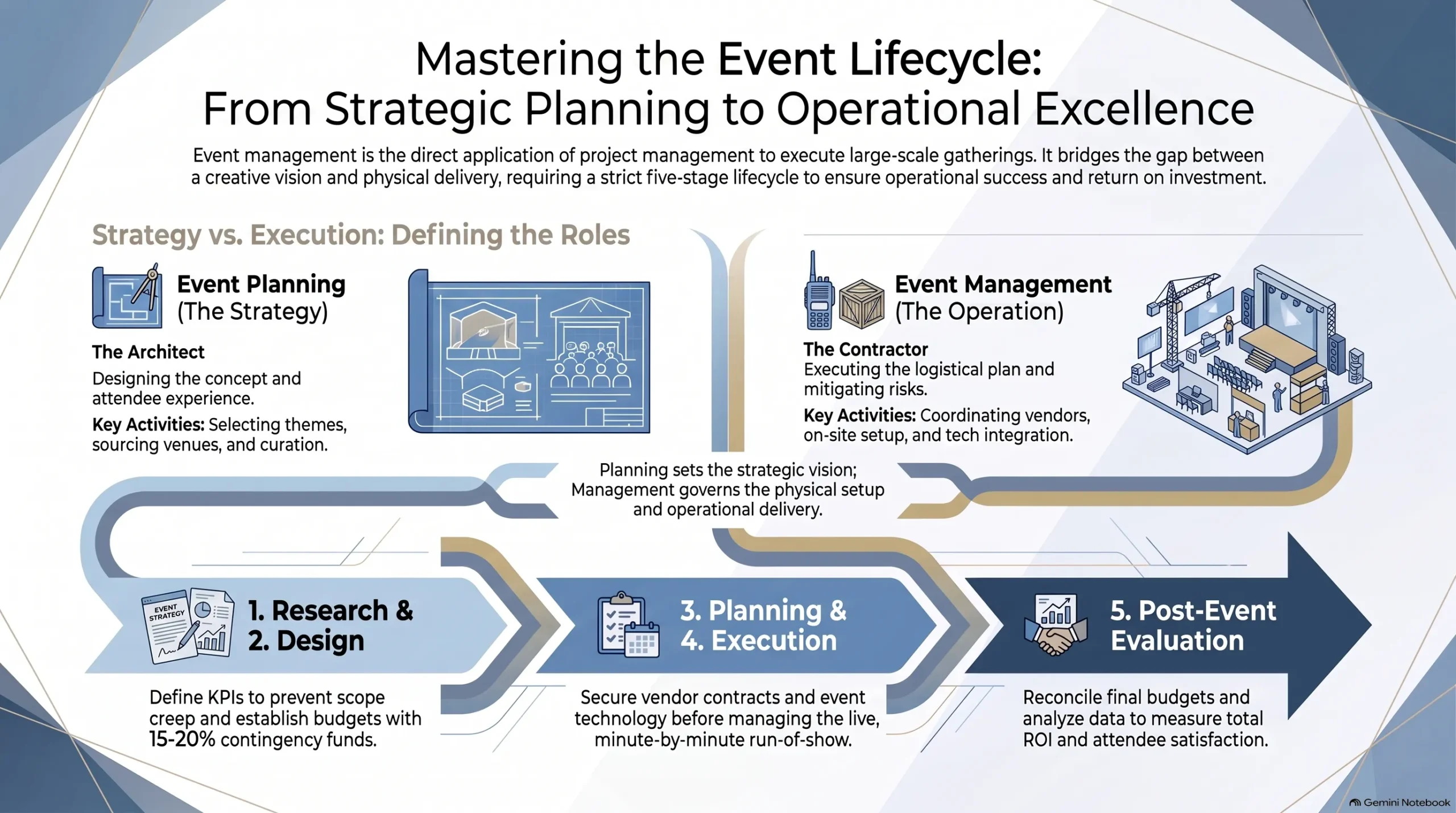
Event planning defines the strategic vision and conceptual framework of a gathering, whereas event management governs the logistical execution required to build that vision. A planner selects the overarching theme, identifies the target audience, and sets the high-level goals. The manager takes those decisions and maps out the exact workflows, staff schedules, and safety procedures needed to make the event happen.
While these roles overlap in smaller organizations, they represent distinct phases of the event lifecycle. The planner acts as the architect designing a house, and the manager acts as the general contractor building it. When analyzing event planning vs event management, the main distinction lies in strategy versus operation.
| Area of Focus | Event Planning | Event Management |
|---|---|---|
| Primary Objective | Designing the concept, setting goals, and defining the attendee experience. | Executing the logistical plan, controlling operations, and mitigating risks. |
| Daily Responsibilities | Selecting themes, establishing budgets, sourcing venues, and curating speakers. | Coordinating vendors, managing site setup, overseeing tech integrations, and directing staff. |
| Execution Phase | Focus on pre-event strategy, concept approvals, and early stage design. | Focus on active pre-event logistics, live on-site control, and post-event ROI measurement. |
An event coordinator often bridges these two areas, assisting both planners and managers with administrative tasks, scheduling, and direct attendee communication. For large-scale corporate events, separating the planning vision from the management execution ensures that creative decisions do not interfere with operational safety and budget control.
The 5 Stages of the Event Management Process
The event management process is a sequential framework divided into five distinct stages: research, design, planning, execution, and evaluation. This lifecycle structure ensures that every logistical detail, from initial budgeting to post-event ROI calculation, follows a strict timeline and moves the project toward a measurable business outcome.
1. Research and Goal Setting
Research and goal setting dictate the event’s exact purpose, target audience parameters, and measurable key performance indicators. An event manager establishes whether the goal is direct revenue generation, brand awareness, internal team alignment, or lead capture.
During this initial phase, the management team defines the demographic profile of the attendees and sets hard metrics for success. These metrics might include specific ticket sales targets, expected sponsor revenue, or the exact number of qualified leads the sales team needs to capture. Clear goal setting prevents scope creep later in the project timeline.
2. Design and Budgeting
Design and budgeting transform the event’s goals into a financial and structural blueprint. You allocate specific monetary values to every requirement, including catering, audio-visual equipment, staffing, and venue rental, while integrating the creative theme into the physical space.
Managers draft a strict budget document that accounts for fixed costs, variable costs, and a mandatory contingency fund. Setting aside 15 to 20 percent of the total budget for unexpected expenses protects the project from sudden vendor price increases or emergency logistical changes. The design aspect ensures the physical layout and decor align with the financial realities established in the budget.
3. Planning and Logistics
The planning and logistics stage focuses on contracting vendors, securing physical spaces, and mapping out the event technology stack. This phase turns theoretical plans into binding agreements and concrete operational schedules.
Professionals handle venue sourcing by comparing locations based on capacity, accessibility, and technical infrastructure. They negotiate vendor contracts, obtain necessary municipal permits, and build the registration workflows. Modern logistics also require heavy reliance on specialized software to handle both in-person and digital attendees.
“The integration of advanced event technology platforms has shifted from a luxury to an operational necessity, allowing planners to manage data flow, hybrid streaming capabilities, and secure ticketing within a single ecosystem.”
Source: Skift Meetings
4. Execution and On-Site Coordination
Execution and on-site coordination require managing the physical run-of-show, directing staff, and resolving active crises on the event day. The event manager controls the minute-by-minute schedule to keep speakers, vendors, and attendees synchronized.
This is the operational test of the entire process. The management team oversees the load-in process, enforces health and safety protocols, and acts as the central point of contact. If a keynote speaker arrives late or a microphone fails, the manager enacts a contingency plan silently to maintain a seamless experience for the guests.
5. Post-Event Evaluation
Post-event evaluation involves reconciling final budgets, surveying attendees, and calculating the exact return on investment. This phase determines if the gathering achieved the initial goals established during the research stage.
Managers analyze registration data, review lead capture efficiency, and process attendee survey responses to measure satisfaction. They also close out all vendor payments and compile a final performance report for stakeholders, detailing what worked and what requires adjustment for future projects.
| Stage | Primary Focus | Key Deliverables |
|---|---|---|
| Research | Strategy and metrics | Goal definition, KPI outlines, audience targeting |
| Design | Financials and aesthetics | Master budget, contingency fund, theme selection |
| Planning | Contracts and schedules | Venue contracts, permit approvals, tech integration |
| Execution | Live operations | Run-of-show execution, crisis management, staff direction |
| Evaluation | Data and finance | ROI calculation, budget reconciliation, attendee surveys |
Types of Events Managed by Professionals
Professional event management categorizes into three primary sectors: corporate B2B gatherings, private social functions, and hybrid broadcast operations. The operational demands shift drastically depending on the category. A product launch requires strict brand compliance and lead tracking, while a private gala focuses on guest experience and high-end vendor coordination. You must adjust your logistical framework to match the specific outcome the client expects.
Corporate and B2B Events
Corporate and B2B events exist to drive revenue, train employees, or generate sales leads. Managers in this sector handle large-scale trade shows, multi-day industry conferences, product launches, and educational seminars. The logistics heavily involve processing thousands of registrations, managing sponsor booths, and securing large-scale audio-visual setups for keynote presentations.
Budget allocation in corporate settings prioritizes attendee data capture and event marketing ROI over pure aesthetics. You are managing a business asset, meaning your performance is judged by how many qualified leads the sales team captured or the volume of products sold on the trade show floor.
Private and Social Events
Private and social events encompass high-budget weddings, charity galas, and exclusive VIP networking mixers. The operational focus here shifts from corporate lead generation to flawless guest experience and strict timeline execution. You must coordinate highly specialized vendors, including premium catering, live entertainment, and custom venue fabrication.
Risk management in this category deals with crowd control, managing high-profile guests, and adhering to strict municipal noise and alcohol licensing permits. An error in a timeline during a live corporate seminar can often be smoothed over, but a catering delay at a high-end social gala directly damages the host’s reputation.
Virtual and Hybrid Events
Virtual and hybrid events require broadcasting live content to a digital audience while simultaneously running an in-person gathering. This category demands deep technical literacy. Managers oversee streaming bandwidth, camera switching, digital attendee engagement software, and the synchronization of physical stage presentations with virtual breakout rooms.
Connecting an online audience with physical attendees introduces complex risks regarding internet stability, platform security, and attention retention. You are effectively managing two overlapping timelines.
“Producing a successful hybrid event requires event organizers to essentially plan two different events simultaneously. You have to map out a dedicated journey for the in-person attendee and a distinct, equally engaging journey for the virtual attendee.”
Source: Cvent
A failed internet connection or a crashed streaming platform instantly ends a virtual event. Therefore, your contingency planning must include backup internet service providers, redundant hardware, and pre-recorded video fallbacks for live speakers.
| Event Category | Primary Focus | Primary Success Metric |
|---|---|---|
| Corporate and B2B | Revenue generation, education, brand alignment | Return on investment, qualified sales leads |
| Private and Social | Guest experience, fundraising, aesthetic execution | Guest satisfaction, total funds raised |
| Virtual and Hybrid | Digital reach, platform stability, simultaneous execution | Platform engagement rates, total viewership |
What Does an Event Manager Actually Do? (Skills & Realities)
An event manager translates event concepts into controlled, real-world operations by directing vendors, tracking budgets, negotiating contracts, and troubleshooting on-site problems in real time. Their primary work centers on risk management, schedule enforcement, and cross-functional team leadership so that an event runs without operational failures.
Essential Skills for Success
Succeeding in event management requires a mix of technical hard skills and interpersonal abilities to handle strict, non-negotiable deadlines.
| Skill Category | Core Competency | Practical On-Site Application |
|---|---|---|
| Logistical and Financial | Budget allocation and contract negotiation | Preventing cost overruns and holding vendors accountable to service-level agreements. |
| Technical Literacy | Event technology and audio-visual setups | Managing hybrid stream latency, registration databases, and staging infrastructure. |
| Crisis Management | Rapid problem-solving under pressure | Resolving power drops, weather delays, or missing inventory without alarming guests. |
| Direct Communication | Clear command and team coordination | Briefing security, production teams, and venue staff with concise instructions. |
A Day in the Life (Expertise & Experience)
At 6:30 AM on the opening morning of an 800-attendee corporate conference, the primary catering supplier calls to report that their main transport van broke down 40 miles away, stranding the entire morning coffee and food order ninety minutes before check-in begins. A novice might waste time waiting for updates or panicking. An experienced event manager immediately activates an established backup protocol.
The manager calls a pre-vetted local bakery service to dispatch breakfast items on an emergency rush order, while simultaneously directing the hotel banquet staff to bring out emergency coffee stations from their own kitchen. By 7:45 AM, the food and beverage stations are fully stocked, the audio-visual engineers finish their final stage checks, and the doors open on schedule. The attendees enjoy their morning without ever knowing a supply failure occurred. That quiet, decisive problem-solving is what defines operational expertise in this field.
Event Management Technology: Tools You Need
Modern event technology systems automate operational workflows, centralize attendee data, and streamline communication between organizers, venues, and participants. Using a dedicated software stack replaces fragmented spreadsheets with unified dashboards that track ticket sales, room capacities, and real-time attendee interactions across in-person and digital environments.
Registration and Ticketing Platforms
Registration and ticketing software handles payment processing, badge printing, credential verification, and attendee intake. These platforms collect user information securely, sync ticket tiers directly with company customer relationship management databases, and enforce capacity limits automatically.
Organizers use these systems to establish customized intake forms, apply discount codes, and issue instant digital receipts with unique QR codes for on-site scanning. By centralizing registration data, management teams track drop-off rates in the purchasing funnel and forecast actual attendance numbers weeks before the event begins.
Event Apps and Engagement Tools
Mobile event apps provide attendees with personalized agenda builders, interactive floor plans, live speaker polling, and direct networking directories. These tools keep participants informed about schedule changes through targeted push notifications while gathering live session feedback for the organizers.
During live presentations, engagement tools allow moderators to collect, filter, and display audience questions on main stage screens in real time. This functionality bridges the gap between in-person audiences and remote participants during hybrid events, giving both groups an equal voice in discussions.
| Technology Category | Primary Functions | Operational Benefit |
|---|---|---|
| Registration and Ticketing | Payment processing, intake forms, QR check-in | Reduces line bottlenecks and secures attendee records. |
| Mobile Event Apps | Wayfinding, schedule updates, push alerts | Delivers instant schedule changes directly to attendees. |
| Audience Engagement | Live polling, Q&A moderation, surveys | Increases participation and captures session feedback. |
The Future of Event Management: Trends to Watch
Future operations in this industry rely on strict environmental accountability and the integration of predictive artificial intelligence. Professionals must incorporate zero-waste logistics, carbon footprint tracking, and automated data processing directly into their standard workflows, treating these elements as baseline requirements rather than optional upgrades.
Sustainability and “Green” Events
| Sustainability Pillar | Key Green Protocols | Practical On-Site Actions |
|---|---|---|
| Vendor & Material Sourcing | Enforce waste reduction contracts and prioritize local supply chains. | Replace single-use plastics with compostable alternatives and audit catering materials. |
| Energy & Digitalization | Transition away from physical print materials and select certified green spaces. | Use digital displays instead of printed signage and book venues with verified energy efficiency ratings. |
| Logistics & Carbon Tracking | Measure and analyze carbon emissions across all transport and operational choices. | Calculate attendee travel footprints and allocate budget funds for certified carbon offset programs. |
| Framework & Standards | Align event operations with recognized international green guidelines. | Adopt standardized event sustainability checklists from the Events Industry Council. |
Implementing sustainable protocols requires measuring carbon emissions, sourcing local materials, and enforcing waste reduction contracts with all active vendors. You evaluate the environmental impact of every logistical choice, from how staging equipment is transported to the specific materials used by the catering team.
Following frameworks established by organizations like the Events Industry Council helps standardize these efforts. Executing a green operation means replacing single-use plastics with compostable alternatives, utilizing digital displays instead of printed signage, and contracting venues that hold verified energy efficiency ratings. Managers also calculate the carbon footprint generated by attendee travel and allocate budget funds to certified carbon offset programs.
AI and Data-Driven Personalization
Artificial intelligence systems optimize logistical operations by automating intake workflows, forecasting physical crowd movement, and matching attendees based on direct behavioral data. Machine learning algorithms process past registration cycles to predict exact attendance numbers, which allows you to adjust food guarantees and room capacities before incurring unnecessary expenses.
On the attendee side, data-driven matchmaking software analyzes participant profiles to recommend specific educational sessions and instantly connect professionals with overlapping business interests. Management teams also deploy AI chatbots to resolve immediate guest questions regarding schedule shifts or venue navigation, reserving human staff strictly for complex operational troubleshooting.
Conclusion: Mastering the Art of the Event
Event management requires controlling physical variables, mitigating logistical risks, and enforcing strict timelines to deliver a specific operational outcome. Success in this field depends heavily on mastering budget allocation, vendor negotiations, and immediate crisis resolution rather than focusing solely on conceptual design. You are building a temporary infrastructure that must execute flawlessly on a non-negotiable date.
Professional standards adjust constantly alongside new event technology integrations and mandatory sustainability protocols. Advancing your career demands ongoing technical and operational education. Pursuing formal credentials, such as the Certified Special Events Professional (CSEP) designation, and actively testing new hybrid registration software ensures your operational skills match current market demands.
To structure your next operational rollout, download our free 12-month event management timeline and checklist. This resource provides a step-by-step framework for tracking vendor deadlines, building accurate contingency budgets, and securing necessary venue permits.
Frequently Asked Questions
What is the difference between event management and event planning?
Event planning focuses on the early creative vision, theme selection, and conceptual goals of a gathering, whereas event management handles on-site operational execution, vendor logistics, timeline enforcement, and live troubleshooting. Planners design what the experience looks like, and managers build the technical and physical infrastructure to deliver that experience safely.
What qualifications do you need to get into event management?
You do not need a mandatory state license to enter the field, though employers regularly prioritize candidates with degrees in hospitality management, public relations, communications, or business. Obtaining recognized industry certifications, such as the Certified Special Events Professional (CSEP) or Certified Meeting Professional (CMP), establishes professional credibility and verifies your operational competency.
Is event management a stressful career?
Event management consistently ranks among high-stress professions due to non-negotiable delivery deadlines, unexpected technical issues, and live operational pressures. Experienced managers reduce this stress by building detailed contingency budgets, running rehearsals, and maintaining clear communication protocols with all suppliers.
What software is most commonly used in event management?
Event managers rely on specialized software platforms such as Cvent, Eventbrite, Whova, and Bizzabo to process registrations, issue digital tickets, and run mobile event apps. They also use general project management platforms like Asana or Monday.com alongside floor-planning software to track setup schedules and spatial layouts.
How do event managers measure the success of an event?
Success is measured by evaluating post-event performance against the specific goals set during the research stage. Common metrics include net revenue generated, cost-per-lead acquisition for corporate sales teams, attendee survey satisfaction scores, and how closely actual expenditures aligned with the initial budget allocation.


