
Event marketing is a measurable, interactive promotional channel where brands connect directly with targeted buyers through curated in-person, virtual, or hybrid experiences. For business managers, it is not about hosting a corporate party; it is a strategic, pipeline-generation engine designed to capture first-party data, instantly qualify leads, accelerate the sales cycle, and position the brand as a dominant industry authority.
What is Event Marketing?
Event marketing is a promotional strategy that involves direct, interactive contact between a brand and its target audience through curated experiences. When integrating events into your business development strategy, it is not just about hosting a corporate party; it is a measurable revenue channel designed to generate qualified leads, accelerate the sales pipeline, and maximize customer retention. Instead of pushing static ads, you are creating an immersive environment where prospects can experience your product, company culture, and industry expertise firsthand. A prime example is Salesforce’s Dreamforce—what looks like a massive tech festival is actually a highly orchestrated pipeline-generation engine that drives billions in enterprise sales.
Core Event Formats
The format you choose directly dictates your budget, global reach, and the depth of audience engagement. Modern event marketing relies on three primary delivery methods, each serving a distinct business objective.
Here is a breakdown to help you allocate your marketing budget effectively:
| Event Format | Best For | Practical Managerial Example |
| In-Person | High-value networking, deep trust building, and closing enterprise deals. | Hosting an exclusive, invite-only VIP dinner for 15 C-level prospects during an industry conference. |
| Virtual | Scaling global reach, rapid lead generation, and cost-effective education. | Running a targeted product demo or thought-leadership webinar using platforms like Livestorm or Zoom. |
| Hybrid | Maximizing both local physical engagement and international accessibility. | Hosting a physical product launch where the keynote is live-streamed globally via an event app. |
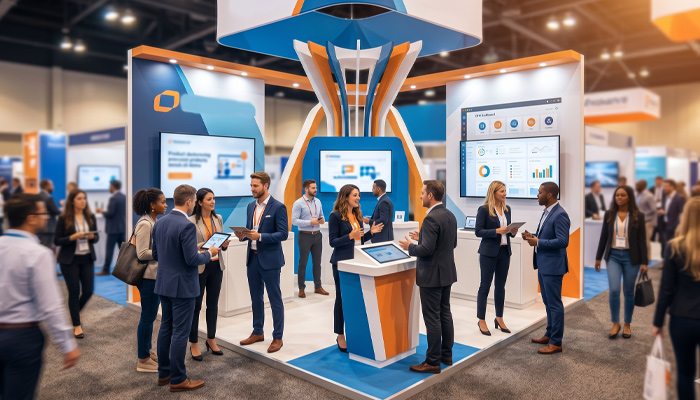
Beyond the delivery medium, you will deploy specific event types based on your goals. Trade shows place you directly in front of active buyers, demanding high-impact booth experiences to capture foot traffic. Workshops and seminars position your brand as an industry educator, trading valuable training for high-quality contact data.
Why Event Marketing Matters
Event marketing matters because it dramatically accelerates trust, cutting through the digital noise that plagues traditional marketing channels. While a digital ad campaign or email sequence might take months to warm up a cold lead, a 20-minute face-to-face conversation at an event can instantly qualify a prospect and move them directly to the negotiation stage.
From a management perspective, investing in events provides three distinct advantages:
-
First-Party Data Collection: Using event management software (like Cvent or Eventbrite), you capture highly accurate contact information and behavioral data directly from the attendees.
-
Increased Pipeline Velocity: B2B buyers are significantly more likely to sign a contract after they have physically interacted with your product and shaken hands with your account executives.
-
Authority Positioning: Hosting or heavily sponsoring an event shifts your brand’s perception from a mere “vendor” to an “industry authority.” Think of how HubSpot’s INBOUND event allows them to dictate the inbound marketing narrative for the entire year.
Types of Event Marketing
The type of event you deploy must directly align with your immediate business objective—whether that is filling the top of your sales funnel, accelerating existing pipeline, or retaining high-value clients. Selecting the wrong format wastes budget and misaligns with buyer expectations.
Here are the most effective types of event marketing for B2B and B2C brands:
-
Trade Shows and Exhibitions: These are massive industry gatherings where you secure booth space to showcase your product to a highly concentrated market. They are primarily top-of-funnel (TOFU) plays designed to capture a high volume of leads, scan badges, and assess competitor positioning in real-time.
-
Conferences: Whether you host your own user conference (like Apple’s WWDC) or sponsor an existing one, conferences are engines for thought leadership. They combine keynotes, breakout sessions, and networking, making them ideal for educating your market, upselling current customers, and building long-term brand authority.
-
VIP Executive Dinners: A critical staple in Account-Based Marketing (ABM). You invite 10 to 15 high-level decision-makers (usually C-suite or VPs) to an exclusive, high-end dinner. The goal is never volume; it is about closing highly qualified, enterprise-level deals by fostering deep, personal trust in an intimate, low-pressure environment.
-
Seminars and Workshops: These are tactical, focused educational sessions. Attendees trade their contact information for actionable training or certifications. This format is highly effective for warming up mid-funnel leads who understand their problem but need expert, hands-on guidance to solve it.
-
Product Launches: High-energy, highly produced events focused entirely on introducing a new product or feature to the market. The primary metrics here are generating press coverage (PR), social media buzz, and securing immediate early-adopter sales.
| Event Type | Primary Business Goal | Target Audience Stage |
| Trade Shows | High-volume lead generation | Top of Funnel (Awareness) |
| Seminars | Lead nurturing & education | Middle of Funnel (Consideration) |
| VIP Dinners | Pipeline acceleration & closing | Bottom of Funnel (Decision) |
How to Build an Event Marketing Strategy
An event marketing strategy is a documented roadmap that aligns your physical or virtual event with specific, measurable business outcomes. It transforms event planning from a simple logistical checklist into a targeted, revenue-generating campaign. To execute a successful event, managers must treat it like a major product launch, requiring strict alignment between marketing, sales, and operations to ensure a positive Return on Investment (ROI).
1. Define Goals and Set KPIs
Your event must serve a distinct, quantifiable business purpose—whether that is generating $1M in sales pipeline, acquiring 500 net-new leads, or securing a 90% renewal rate for enterprise accounts. Vague objectives like “boosting brand awareness” often lead to misallocated budgets. You must attach specific Key Performance Indicators (KPIs) to every goal so your executive team can measure exact success post-event.
| Business Goal | Primary KPI | Practical Measurement Method |
| Pipeline Generation | Opportunities created (in $) | Tracking badge scans directly into your CRM (e.g., Salesforce) |
| Lead Acquisition | Cost Per Qualified Lead (CPQL) | Total event budget ÷ Number of Marketing Qualified Leads (MQLs) |
| Customer Retention | Upsell rate & Net Promoter Score | Comparing attendee vs. non-attendee renewal rates |
2. Identify and Understand Your Target Audience
Define exactly who needs to be in the room to help you hit your KPIs. If you build an event for the wrong demographic, your sales team will waste hours chasing unqualified leads. An event designed for end-users requires deep technical workshops and product certifications, whereas an event targeting economic buyers (CIOs, VPs) demands high-level strategic keynotes and exclusive peer networking.
Map your target audience using precise firmographics (company size, revenue, industry) and job titles. For example, if your goal is enterprise pipeline acceleration, your audience isn’t “anyone interested in software.” It is specifically “C-level decision-makers at SaaS companies with over 500 employees.” Dive into your CRM and interview your sales reps to uncover the exact pain points this specific cohort wants solved.
3. Establish a Budget and Evaluate Resources
Map out every projected expense against your anticipated revenue impact before signing any vendor contracts. A comprehensive event marketing budget must account for both fixed costs (venue rental, AV equipment, event management software like Airtable or Cvent) and variable costs (Food & Beverage, travel, promotional swag).
Crucially, always allocate a 15% to 20% contingency fund for unexpected overages, such as last-minute shipping fees or union labor costs at trade shows. Evaluating resources also means assessing your internal team’s bandwidth. If your marketing department lacks the operational capacity to manage a 1,000-person user conference, you must build the cost of an external event management agency into your core budget.
4. Create a Promotional Timeline
Work backward from your event launch date to build a multi-channel promotional schedule. For a large-scale industry conference, your promotional timeline must begin at least 12 to 16 weeks in advance. A structured timeline prevents last-minute panic and ensures a steady flow of registrations.
Break your timeline into distinct, strategic phases:
-
Weeks 12-16 (Launch & Early Bird): Launch the event landing page, offer discounted “Early Bird” pricing to secure initial cash flow, and activate your sales team to personally invite VIP prospects.
-
Weeks 6-11 (Value Proposition): Announce keynote speakers, workshop agendas, and entertainment. Use tools like Mailchimp to run targeted email sequences.
-
Weeks 1-5 (Urgency & Logistics): Shift messaging to “Last Chance to Register” and “FOMO” (Fear Of Missing Out). Concurrently, send “Know Before You Go” logistical emails to those who have already registered to reduce no-show rates.
Essential Event Marketing Channels
Essential event marketing channels are the targeted distribution networks you use to drive registrations, build pre-event anticipation, and communicate directly with attendees. Relying on a single channel is a critical mistake; a successful promotional strategy requires an omnichannel approach, ensuring your brand stays visible across every touchpoint of your target audience’s daily digital routine.
The Event Website and Registration Page
Your event website is your central conversion hub—the final destination where all other marketing channels direct traffic. For business managers, this page must be engineered as a high-converting sales asset, not just an informational brochure. It must instantly answer three questions: What is the ROI of attending, who are the marquee speakers, and how much does it cost?
A frictionless registration experience is paramount. If a prospect encounters a slow, complicated, five-step checkout process, your cart abandonment rate will skyrocket. Utilize dedicated event management software (like Cvent, Eventbrite, or Bizzabo) to embed secure, seamless registration forms and payment gateways directly onto the landing page.
Email Marketing
Email marketing remains the highest-converting channel for B2B event registrations, consistently driving the majority of direct ticket sales. It grants you direct, personalized access to your most valuable asset: your existing CRM database.
A successful event email strategy relies heavily on audience segmentation. You should never send the same email to a cold lead and a five-year enterprise client. Using platforms like Mailchimp or HubSpot, managers must deploy targeted, automated sequences:
-
Loyalty Campaigns: Exclusive VIP invites and heavy discounts for returning attendees.
-
Urgency Sequences: “Price increases at midnight” emails to drive immediate action.
-
Nurture Campaigns: Weekly speaker reveals and agenda highlights to convert hesitant prospects.
Social Media & Hashtags
Social media transforms event promotion from a one-way corporate broadcast into a dynamic, two-way community conversation. The platform you prioritize must match your audience: LinkedIn is the absolute standard for B2B targeting, allowing you to reach specific job titles and industries, while Instagram or TikTok is essential for visually driven B2C events.
Establishing a short, memorable, and unique event hashtag (e.g., #SaaStrAnnual) is mandatory. A dedicated hashtag aggregates user-generated content, allows attendees to network virtually before arriving, and provides your marketing team with a trackable metric for brand reach. To maximize exposure, provide your sponsors, speakers, and internal employees with pre-written social copy and custom graphics to share with their own networks.
SEO and Content Marketing
SEO and content marketing generate compounding, organic traffic to your registration page, significantly lowering your overall Customer Acquisition Cost (CAC). By publishing high-value content tailored to the themes of your event, you capture prospects actively searching for industry solutions.
This strategy requires a longer runway. Managers should start publishing 3 to 6 months prior to the event date. Publish interviews with keynote speakers, release “lessons learned” whitepapers from previous years, and write blog posts optimized for high-intent search queries (e.g., “top fintech conferences 2026”). This positions your event as an authoritative resource before the attendee even purchases a ticket.
Paid Advertising
Paid advertising guarantees immediate visibility and allows for hyper-targeted reach when your organic channels plateau. It acts as an accelerator, allowing you to scale registrations predictably by injecting budget into top-performing ads.
Here is a breakdown of how managers should allocate paid event marketing budgets:
| Ad Channel | Best Use Case | Practical Managerial Strategy |
| LinkedIn Ads | B2B lead generation & ABM | Targeting specific job titles (e.g., “VP of Sales”) at pre-selected target accounts. |
| Google Search Ads | Capturing high search intent | Bidding on industry keywords and even competitor event names. |
| Retargeting (Pixel) | Converting bounced traffic | Serving “Early Bird Ending” banner ads to users who visited the registration page but abandoned their cart. |
Proven Promotional Tactics to Boost Attendance
To drive maximum event registration, you must shift potential attendees from passive interest to immediate action using structured urgency, social proof, and expanded distribution channels. Relying solely on organic brand reach is insufficient for scaling attendance; managers must actively incentivize registrations through psychological triggers and strategic partnerships.
Here is a quick managerial overview of how different promotional levers impact your campaign:
| Promotional Tactic | Primary Mechanism | Best Used For |
| Early-Bird Pricing | Financial urgency & FOMO | Securing early cash flow and initial headcount commitments. |
| Referral Programs | Peer-to-peer trust | Lowering Customer Acquisition Cost (CAC) predictably. |
| Partner Marketing | Borrowed audience authority | Expanding reach into new, highly targeted demographics. |
Leverage Early-Bird and Limited-Time Offers
Tiered pricing structures force decision-making and generate crucial early cash flow to fund your remaining marketing efforts. Implementing an “early-bird” discount creates a strict deadline that overcomes buyer procrastination.
To make this work effectively, the price jump must be significant enough to matter to a business budget—typically 15% to 25% off the standard ticket price. Combine this baseline urgency with unexpected, limited-time flash sales (e.g., a “48-Hour Flash Sale for 50% Off”) during notorious slow periods, often called the “event marketing slump” between the launch and the final week. Always display a live countdown timer directly on your registration landing page to visually trigger the fear of missing out (FOMO).
Harness Word-of-Mouth and Referral Incentives
Your current ticket holders are your most persuasive marketers, as buyers trust peer recommendations far more than corporate advertising. By turning attendees into active brand advocates, you drastically lower your cost per acquisition while attracting highly qualified lookalike prospects.
Implement a structured referral program directly integrated into your event management platform. For example, offer a 20% ticket refund or exclusive VIP lounge access to any attendee who gets three colleagues to register using their unique tracking link. For B2B events, utilizing “Bring Your Team” discounts (e.g., “Buy 3, Get 1 Free”) directly incentivizes department heads to purchase group passes, instantly multiplying your headcount per target account and increasing the likelihood of enterprise-wide software adoption or upselling post-event.
Utilize Influencer and Partner Marketing
Partnering with industry figures and complementary brands allows you to instantly bypass the slow process of audience building and directly tap into established, trusting communities.
Do not just hire speakers to show up on the day of the event; contract them as co-promoters. Require your keynote speakers and workshop leaders to post about the event on their LinkedIn profiles or email newsletters as a mandatory clause in their speaking agreement. To ensure compliance, provide them with frictionless promotion kits, including pre-written copy, custom graphics featuring their headshots, and trackable affiliate links. Co-marketing with your event sponsors serves a similar purpose—coordinate joint email blasts to both of your CRM databases to maximize audience overlap and drive mutual booth traffic.
Post on Event Directories
Listing your event on high-traffic, third-party directories captures high-intent prospects who are actively searching for industry gatherings but are not yet familiar with your specific brand. It is a high-ROI, zero-cost strategy to dominate search engine results pages (SERPs) for local or virtual event queries.
Platform selection dictates the quality of your leads. While publishing on general platforms like Eventbrite or LinkedIn Events is mandatory for broad visibility, you must prioritize niche industry boards to capture qualified B2B buyers. Submit your event details to industry association calendars, specialized trade publications, and local Chamber of Commerce boards. These localized and highly specific directories carry immense domain authority, ensuring your event ranks at the top of Google when a prospect searches for “fintech conferences in London” or “SaaS workshops online.”
On-Site Execution and Real-Time Engagement
Flawless pre-event marketing means nothing if the actual attendee experience falls flat on the day of the event. On-site execution is where you convert attendee interest into tangible business value by keeping participants actively engaged rather than passively watching. Managers must transition from promotional mode to experiential management, ensuring every physical and digital touchpoint—from the initial check-in desk to the closing keynote—facilitates networking, product education, and brand interaction.
Leverage Event Technology
Event technology acts as your operational nervous system on the day of the event, transforming a chaotic crowd into trackable, engaged data points. Instead of relying on printed schedules and manual business card collection, you must integrate mobile event apps and smart tech to streamline the attendee journey while simultaneously capturing critical behavioral data for your sales team.
By deploying the right tech stack, you remove friction from the attendee experience and empower your sponsors to prove their ROI instantly. Here is a breakdown of essential on-site technologies:
| Tech Tool | Attendee Benefit | Managerial / Business Value |
| Event Mobile Apps (e.g., Whova) | Personalized agendas & 1-on-1 messaging | Sending real-time push notifications & tracking session attendance |
| RFID / NFC Smart Badges | Frictionless check-in & cashless payments | Instant lead retrieval for sponsors & venue traffic heatmapping |
| Live Polling & Q&A (e.g., Slido) | Anonymous question submission & interaction | Immediate audience feedback & content sentiment analysis |
Encourage User-Generated Content (UGC)
User-Generated Content (UGC) turns your attendees into a massive, highly credible marketing team broadcasting your brand to their respective networks in real-time. Do not just hope people will take pictures; you must deliberately engineer specific, visually appealing moments into your venue layout to guarantee social sharing.
Design physical spaces—like branded photo booths, interactive product installations, or visually striking VIP lounges—that naturally prompt attendees to pull out their phones. To amplify this behavior, set up prominent “social walls” across the venue: large digital screens displaying a live feed of social media posts that include your official event hashtag. This feeds into attendees’ desire for peer recognition and creates a continuous loop of sharing. Additionally, you can gamify the process by utilizing your event app to run a contest, rewarding the most active social media contributors with high-value prizes, such as premium software licenses or free VIP passes for next year’s conference.
Post-Event Marketing and Measurement
The true ROI of an event is realized after the doors close. Post-event marketing is the systematic process of converting the momentum and data captured on-site into measurable pipeline and revenue. If your sales team waits a week to follow up, your conversion rate drops exponentially. Managers must transition immediately from event execution to targeted lead nurturing and rigorous performance analysis.
Follow-Up Communications
Speed to lead is the most critical factor in your post-event strategy. Do not send a generic “thanks for attending” mass email. Instead, segment your follow-up campaigns based on the specific actions attendees took on-site.
Route highly qualified leads—such as decision-makers who attended a VIP dinner or requested a dedicated product demo—directly to your account executives for a personalized phone call or LinkedIn message within 24 hours. For mid-funnel attendees who simply scanned their badge at your booth or downloaded a brochure, drop them into an automated email nurture sequence. This sequence should deliver targeted content, such as case studies or whitepapers, directly related to the product or topic they expressed interest in during the event.
Post-Event Surveys
Send a post-event survey within 24 hours of the event concluding, while the experience is still fresh. To ensure high completion rates, keep the survey concise—under five questions.
The most critical metric to capture here is the Net Promoter Score (NPS), which asks: “On a scale of 0-10, how likely are you to recommend this event to a colleague?” Beyond the quantitative NPS, include one or two open-ended questions asking what specific content was most valuable and what logistical friction they experienced. This qualitative feedback is essential data for managers and executives when optimizing operations and justifying the budget for next year’s event.
Track and Measure Success
You must prove the financial impact of your event by comparing your final data against the exact KPIs you established during the strategic planning phase. Avoid vanity metrics like “overall social media impressions” and focus entirely on hard revenue and pipeline numbers.
Here is what managers need to track to prove event ROI:
| Metric | What It Indicates | How to Measure It |
| Cost Per Acquisition (CPA) | Financial efficiency of the event | Total Event Budget ÷ Number of Marketing Qualified Leads (MQLs) |
| Sales Pipeline Velocity | Impact on the sales cycle | Average time to close for event leads vs. standard inbound leads |
| Total Influenced Revenue | The overall business impact | Total dollar amount of closed-won deals that touched the event campaign in your CRM |
To achieve this level of tracking, you must integrate your event management software directly with your CRM (like Salesforce or HubSpot). This closed-loop reporting allows managers to track exactly which enterprise deals were influenced by a specific trade show badge scan, providing undeniable proof of event success to your executive board.
Conclusion
Event marketing is a measurable revenue engine, not simply a logistical gathering. By aligning your physical, virtual, or hybrid events with strict KPIs—such as pipeline velocity, cost per acquisition, and influenced revenue—you transform attendee interactions into tangible business growth. The success of this strategy hinges on rigorous audience targeting, omnichannel promotion, seamless on-site technology integration, and immediate post-event sales alignment to close deals. Treat every event as a major campaign, and track the data from the first registration click to the final closed-won contract.
Frequently Asked Questions (FAQ)
1. What is the most critical metric for measuring event marketing success?
Total Influenced Revenue and Pipeline Generated are the most critical metrics for business managers. While attendance numbers and brand awareness are useful, proving that the event directly contributed to closed-won deals is the only way to justify the ROI to your executive board.
2. How much of the overall marketing budget should be allocated to events?
For B2B companies, event marketing typically consumes 20% to 30% of the total marketing budget. This percentage scales up if your company relies heavily on enterprise-level, high-ticket sales where face-to-face trust-building is required to close deals.
3. How soon should the sales team follow up with event leads?
Within 24 hours. Speed-to-lead dictates your conversion rate. Highly qualified leads (like VIP dinner guests or product demo requests) require immediate, personalized outreach from an Account Executive, while broader top-of-funnel leads should instantly enter an automated email nurture sequence.
4. Are virtual events still effective for B2B lead generation?
Yes, virtual events remain highly effective for top-of-funnel lead generation, global reach, and cost-efficient product education. While they lack the deep networking capability of in-person events, webinars and virtual conferences are unmatched for scaling audience acquisition quickly.
5. How can we reduce the Cost Per Acquisition (CPA) for event registrations?
To lower your CPA, implement structured referral programs that incentivize current attendees to invite colleagues, utilize early-bird pricing to drive immediate conversions, and co-market with your sponsors to tap into their existing CRM databases without increasing your ad spend.