
B2B events consume up to 20% to 30% of standard marketing budgets, making them one of the most expensive line items on a CMO’s ledger. Yet, when the CEO asks for the exact revenue impact of a six-figure conference sponsorship or an exclusive executive dinner, most marketing leaders are forced to fall back on vanity metrics like badge scans, session attendance, or general booth traffic. You are reading this because “brand awareness” is no longer a defensible justification for your board. You need to definitively prove that your event strategy directly generates high-quality Marketing Qualified Leads (MQLs), accelerates the sales pipeline, and converts into closed-won revenue.
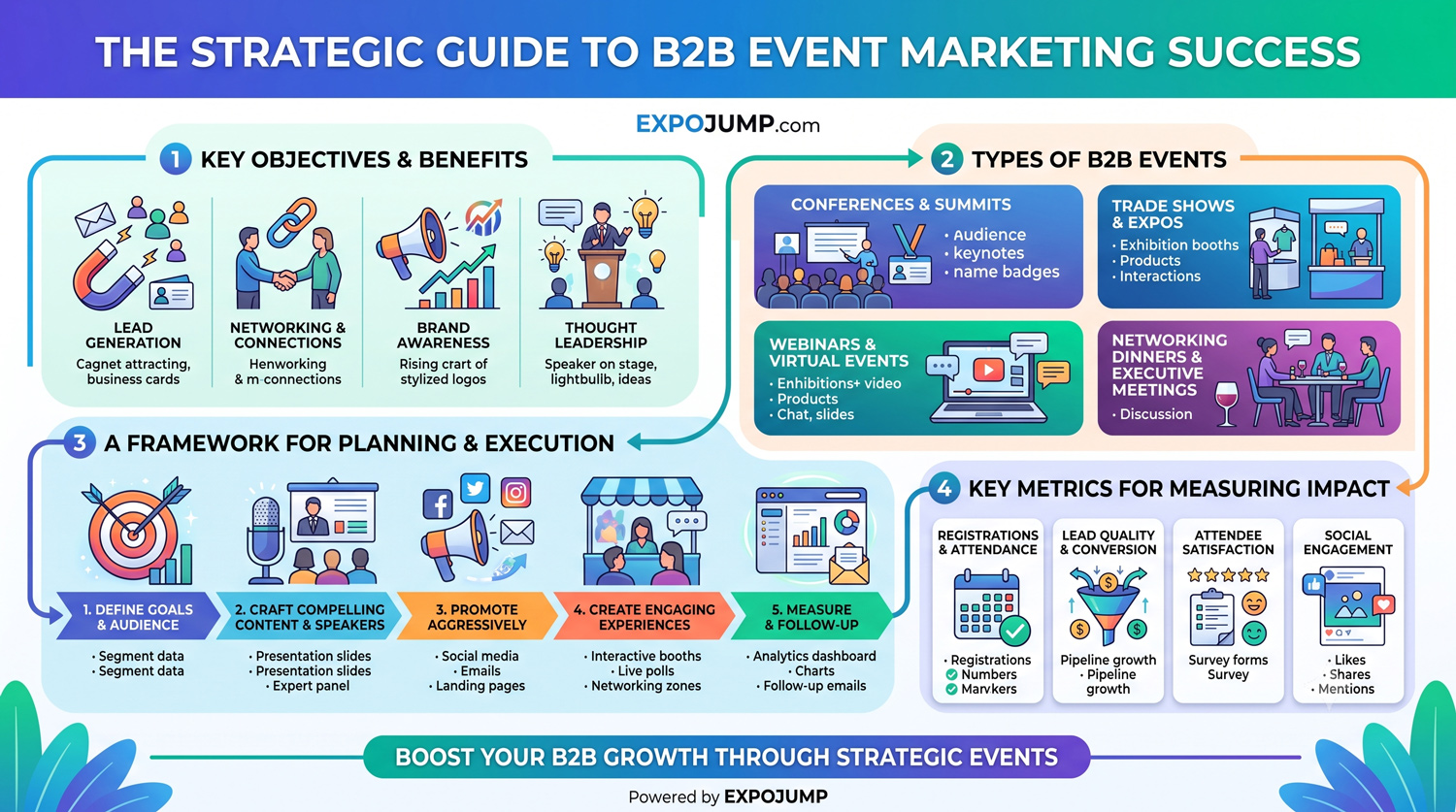
This guide delivers the actionable, 2026-ready roadmap you need to solve this exact ROI dilemma. We are stripping away the outdated, top-of-funnel event playbooks to focus entirely on commercial alignment. Here, you will find the strategic frameworks and modern tracking methodologies required to transform your B2B events from a perceived sunk cost into a highly predictable revenue engine, ensuring you can confidently justify every dollar of your event budget.
What is B2B Event Marketing?
B2B event marketing is the strategic execution of offline, virtual, or hybrid gatherings engineered specifically to engage key decision-makers, accelerate complex sales cycles, and secure high-ticket enterprise contracts. Unlike general promotional events, it operates strictly as a commercial lever for account-based marketing (ABM) and pipeline velocity.
While B2C events rely on spectacle to trigger emotional, impulse purchases from a mass audience, B2B events cater to buying committees who require logical justification, verifiable ROI, and deep trust before signing a contract. In B2B, the primary objective is rarely the sheer volume of attendees; it is the density of qualified buyers in the room. The most lucrative conversions often occur not during the flashy keynote presentation, but in the orchestrated, private 1:1 meeting rooms and executive dinners where trust is solidified.
Here is how the strategic framework of B2B fundamentally diverges from B2C:
| Strategic Pillar | B2B Event Marketing | B2C Event Marketing |
| Core Objective | Lead generation, pipeline acceleration, and targeted client retention | Mass brand awareness, consumer engagement, and immediate sales |
| Sales Cycle | Long-term (months to years) requiring multi-stakeholder consensus | Short-term (minutes to days) driven by individual choice |
| Purchasing Driver | Hard logic, proven ROI, and technical reliability | Emotion, lifestyle alignment, and immediate gratification |
| Primary KPI | Sales Qualified Leads (SQLs), Pipeline generated, Cost per Acquisition (CPA) | Total footfall, social media impressions, immediate POS revenue |
By fully embracing this distinction, growth leaders can stop wasting budgets on B2C-style “awareness” tactics and instead architect environments that systematically move target accounts through the commercial funnel.
Why Event Marketing is the Ultimate B2B Growth Engine
Event marketing serves as the ultimate B2B growth engine because it systematically forces direct, high-stakes engagement with complex buying committees, immediately converting passive digital interest into active, verifiable pipeline. Relying on digital touchpoints alone leaves you vulnerable to ignored emails and skipped webinars. Live environments—whether physical or carefully orchestrated virtual stages—demand attention, build immediate trust, and provide the unscripted interactions necessary to close six- and seven-figure deals.
Accelerating Pipeline Velocity
Live interactions compress months of asynchronous emails, missed calls, and stalled contract reviews into a single, decisive conversation. In a standard B2B sales cycle, building consensus among multiple stakeholders can take anywhere from six to eighteen months. Events physically bring these fragmented buying committees into one room. When a Sales Director can address the technical concerns of a CTO, the budget constraints of a CFO, and the operational needs of an end-user simultaneously over a coffee break or a targeted breakout session, the friction of the sales process drops to zero. This face-to-face environment builds a level of psychological trust that no automated email drip sequence can replicate, fundamentally accelerating the timeline from “prospect” to “closed-won”.
Generating High-Intent Leads
The era of measuring event success by the sheer volume of badge scans and fishbowl business cards is effectively dead; modern B2B event marketing optimizes strictly for high-intent conversations. A list of 500 random booth visitors who simply wanted a free promotional item is a burden on your Sales Development Representatives (SDRs) and inflates your Cost Per Lead (CPL) with zero revenue return. Instead, strategic event marketers architect experiences that filter out unqualified attendees. By tracking session engagement, scheduling pre-qualified 1:1 meetings, and logging detailed qualitative notes from booth interactions directly into the CRM, teams generate highly qualified MQLs and SQLs. These are leads who have explicitly articulated a pain point, engaged with your solution, and agreed to a defined next step.
Powering the ABM (Account-Based Marketing) Strategy
Bespoke, highly curated events are the most effective, yet frequently underutilized, weapons in an Account-Based Marketing (ABM) arsenal for penetrating and closing tier-one enterprise accounts. While massive trade shows serve the broader market, ABM demands hyper-personalization. Executive roundtables, private VIP dinners, and closed-door workshops provide the exclusive, high-value environments that C-suite decision-makers actually want to attend.
| Feature | Standard B2B Event | ABM-Driven Event |
| Audience | Broad industry professionals | Hand-picked target accounts (Tier 1 & 2) |
| Format | Large-scale trade shows, open webinars | Private dinners, exclusive executive roundtables |
| Content Focus | General industry trends, product demos | Highly customized solutions for specific account pain points |
By aligning your event strategy directly with your ABM target list, you guarantee that every marketing dollar spent is directed at accounts with the highest potential Lifetime Value (LTV). You are no longer hoping the right buyer walks past your booth; you are personally inviting them to a curated experience designed specifically to win their business.
Core Types of B2B Events (And When to Use Them)
B2B event formats are not interchangeable; each serves a specific, mathematical function within your sales funnel. Deploying the wrong format for your objective—such as sponsoring a massive, generalized summit when your actual goal is to close five specific enterprise accounts—guarantees a negative ROI. To drive commercial outcomes, you must align your event type directly with your pipeline requirements: generating net-new awareness (Top of Funnel), educating active prospects (Middle of Funnel), or accelerating late-stage contract negotiations (Bottom of Funnel).
Trade Shows & Large Conferences
Trade shows and industry megaconferences are your highest-volume lead generation engines and market positioning tools. You deploy these when the primary objective is macro-level brand presence and filling the top of your sales funnel with a high quantity of net-new MQLs. The commercial advantage here lies in competitive proximity and sheer scale—allowing you to scan the broader market, launch new products, and gather competitive intelligence in real time. However, because attendee intent is highly diluted, profitability requires strict pre-event qualification frameworks and aggressive, localized SDR follow-up to separate casual window-shoppers from active buyers.
Checkout our exhibition marketing blog post.
Field Marketing, VIP Dinners & Masterminds
Executive dinners, closed-door masterminds, and localized field marketing events are precision instruments built exclusively for Bottom-of-Funnel (BoFu) conversions and ABM alignment. You execute these to accelerate stalled pipeline, cross-sell to existing enterprise clients, or secure meetings with tier-one decision-makers who actively avoid crowded expo halls. By stripping away the noise of a 10,000-person conference, you engineer an intimate, high-trust environment where C-suite executives can discuss sensitive, specific business challenges peer-to-peer. The success metric here is entirely decoupled from volume; it is measured solely by the total pipeline value represented by the 15 people sitting around the dinner table.
Webinars & Virtual/Hybrid Summits
Virtual events, webinars, and hybrid summits scale your thought leadership and product education globally at a fraction of the Cost Per Acquisition (CPA) associated with physical events. These formats are your Middle-of-Funnel (MoFu) workhorses. They excel at engaging prospects who are actively researching solutions but are not yet ready to commit to a 1:1 sales call. Beyond cost efficiency, virtual and hybrid models offer unparalleled behavioral data capture. Your revenue operations team can track exactly which sessions a prospect watched, the polls they answered, and their specific drop-off points, providing your sales team with highly contextual, high-intent triggers for targeted outreach.
| Event Format | Funnel Stage | Primary Objective | Key Performance Indicator (KPI) |
| Trade Shows | Top of Funnel (ToFu) | Broad lead generation & market presence | Total MQLs generated, Cost Per Lead (CPL) |
| Virtual/Webinars | Middle of Funnel (MoFu) | Product education & thought leadership | Engagement rate, Content downloads, MQL to SQL conversion |
| VIP Dinners/Field | Bottom of Funnel (BoFu) | ABM penetration & pipeline acceleration | Deal velocity, Closed-won revenue, Target account engagement |
The 3-Phase B2B Event Marketing Strategy
A successful B2B event marketing campaign is a continuous operational timeline, not a single date on a calendar. The majority of your ROI is secured weeks before the venue doors open and finalized months after the lights go out. Relying on spontaneous foot traffic is a guaranteed path to negative ROI. To extract actual commercial value, your event execution must be divided into three distinct, highly managed phases: pipeline priming, on-site data capture, and structured revenue follow-up.
Phase 1: Pre-Event (Pipeline Priming)
If your sales team is waiting until the event floor opens to start selling, you have already lost to competitors who prepared. The pre-event phase is entirely about pipeline priming: securing locked-in meetings with key accounts before they even pack their bags.
Start by acquiring the attendee list or finalizing your Target Account List (TAL) 60 to 90 days out. Deploy a coordinated, multi-touch outreach sequence combining personalized email campaigns, direct LinkedIn messaging from your C-suite to theirs, and hyper-targeted account-based ads. The primary KPI in this phase is not email open rates or landing page views; it is the exact number of calendar invites accepted by decision-makers. A high-performing B2B team arrives at the venue with their schedules already 70% to 80% booked with qualified prospects.
Phase 2: During the Event (Execution & Capture)
On-site execution must aggressively shift from passive booth-sitting to structured data capture and targeted networking. Every conversation must be digitized, contextualized, and logged in real-time.
Equip your field team with advanced lead retrieval software that integrates instantly with your CRM. Move beyond simple badge scans by training your SDRs and Account Executives to log qualitative context—specific pain points discussed, current tech stack, budget cycles, and explicitly agreed-upon next steps. Furthermore, introduce commercial gamification. Instead of consumer-style giveaways (which attract unqualified leads), deploy interactive ROI calculators, maturity assessments, or live benchmark audits at your booth. These tools require attendees to input real business data in exchange for a custom report, instantly filtering out “swag-hunters” and forcing high-value, solution-oriented conversations.
Phase 3: Post-Event (The Fortune is in the Follow-up)
More than 70% of B2B event leads are never followed up on by sales teams, making the post-event phase the single biggest point of revenue leakage in the industry. Sending a generic “Thanks for stopping by our booth” mass email on the following Monday is not a strategy; it is a waste of budget.
Within 24 hours of the event closing, all captured data must be mapped accurately into your CRM and strictly segmented based on the intent demonstrated on-site. Execution speed and contextual relevance are your ultimate competitive advantages here.
| Lead Segment | Criteria (Intent Level) | Post-Event Action Plan |
| Hot (SQL) | Explicitly requested a meeting, demo, or pricing proposal. | Immediate, personalized 1:1 outreach from the Account Executive within 24 hours. Bypass automated marketing. |
| Warm (MQL) | Engaged in a meaningful booth conversation or attended a deep-dive session. | Enter into a 30-day targeted email sequence featuring case studies directly related to the pain points discussed. |
| Cold (Lead) | Scanned badge for a report or briefly visited the booth with no specific need. | Add to standard monthly newsletter or general MoFu nurture tracks for long-term brand awareness. |
How to Measure B2B Event Marketing ROI
To accurately measure B2B event marketing ROI, you must calculate the exact ratio of net revenue generated against your total event expenditure, completely discarding vanity metrics like booth traffic or general brand impressions. The fundamental formula your CFO requires is: Event ROI = [(Gross Profit from Event Sourced Deals – Total Event Cost) / Total Event Cost] x 100.
Crucially, your “Total Event Cost” must be comprehensive. It is not just the sponsorship ticket; it must include booth fabrication, software licenses (lead retrieval), travel and accommodation (T&E) for the sales team, client dinners, and the internal labor hours spent on pre-event outreach. Furthermore, measuring ROI requires strict attribution rules in your CRM. Because B2B sales cycles take months, you must implement a multi-touch attribution model to track revenue that closes three, six, or twelve months after the event ends.
Top KPIs Every B2B Marketer Must Track
Transitioning your event strategy from a cost center to a predictable revenue engine requires tracking commercial metrics that directly impact the bottom line. Stop reporting on “total attendees” and start measuring the precise efficiency of your pipeline generation.
Here are the critical performance indicators you must track for every event:
| Event KPI | Commercial Definition | Calculation / Impact |
| Cost Per Qualified Lead (CPQL) | The true cost of acquiring a prospect who fits your Ideal Customer Profile (ICP) and has agreed to a sales conversation. |
Total Event Spend ÷ Number of SQLs.
This is far superior to standard Cost Per Lead (CPL), which is heavily skewed by unqualified badge scans. |
| Event Customer Acquisition Cost (CAC) | The total expense required to win a net-new customer directly from the specific event. |
Total Event Spend ÷ Net New Customers Closed.
Compare your Event CAC against your digital channels to justify future event budgets. |
| Lead-to-Opportunity Conversion Rate | The percentage of raw event contacts that successfully transition into active pipeline deals within a specific timeframe (e.g., 90 days). |
(Number of CRM Opportunities ÷ Total Event Leads) x 100.
A low rate here exposes poor pre-event targeting or failing post-event follow-up. |
| Pipeline Sourced vs. Influenced | Differentiates between net-new deals created by the event vs. existing deals that were accelerated by meeting at the event. |
Sourced: Event is the first touchpoint.
Influenced: Event is a mid-cycle touchpoint. Both are vital for proving total event value. |
By mapping these KPIs directly into your CRM dashboards, marketing leaders can definitively prove which conferences drive actual growth and which sponsorships should be cut from next year’s budget.
The Essential B2B Event Tech Stack
Maximizing event ROI requires an integrated tech stack that automatically syncs attendee behavior data directly with your CRM to eliminate manual data entry. If your event tools do not communicate with your core sales database in real time, you will fail to capture late-stage pipeline opportunities. A modern, revenue-driven B2B event tech stack relies on three critical layers working in tandem: Event Management Software (EMS), Lead Retrieval & Data Enrichment tools, and your centralized Customer Relationship Management (CRM) system.
1. Customer Relationship Management (CRM) Systems
Your CRM—typically Salesforce or HubSpot—serves as the single source of truth where all event data must ultimately land. Instead of treating event registrations as isolated contacts, your CRM architecture must map them directly to existing target accounts (for ABM strategies) or route net-new leads through precise lead-scoring workflows. This ensures that when a prospect interacts with your booth, their account executive is automatically notified via an internal system alert.
2. Event Management Software (EMS)
Platforms like Cvent, Bizzabo, and InEvent handle the operational logistics of registration, ticketing, session tracking, and virtual streaming. The commercial value of a top-tier EMS lies in its behavioral tracking capabilities. The software registers which keynotes an enterprise prospect attended, how long they stayed, and what questions they asked during live Q&A sessions, turning abstract attendance into concrete buyer-intent data.
3. Lead Retrieval & Enrichment Tools
On the expo floor, tools like BCard, Captello, or built-in EMS scanners replace manual business card collection with rapid digital logging. To maximize sales efficiency, combine these scanners with real-time data enrichment tools like ZoomInfo or Clearbit. This integration instantly appends critical enterprise data—such as company revenue, funding stage, and exact job titles—to a scanned badge on the spot, allowing your on-site sales team to prioritize high-value buyers immediately.
[EMS (Registration & Behavioral Tracking)]
                 │
                 ▼
[Lead Retrieval & Enrichment Tools (ZoomInfo/Captello)]
                 │
                 ▼
[Centralized CRM (Salesforce/HubSpot)] ──> [Automated AE Follow-up]
Operational Check: Before signing any event vendor contract, verify that their API supports native, bi-directional syncing with your CRM. If data extraction requires manual CSV exports, the delay will kill your post-event sales velocity.
Future Trends in B2B Event Marketing (2026 & Beyond)
B2B event marketing in 2026 has fundamentally transitioned from manual coordination and generic programming to AI-orchestrated, zero-waste experiences. Success no longer depends on the sheer scale of the venue, but on the depth of technological personalization and the ethical execution of the event itself. To maintain a competitive edge and secure enterprise-level attendance, marketing leaders must immediately integrate three non-negotiable strategies into their event playbooks: algorithmic matchmaking, account-based hyper-personalization, and measurable sustainability mandates.
AI-Driven Networking and Matchmaking
The days of leaving high-value B2B networking to chance encounters at the coffee station are over. Modern event platforms now utilize predictive AI algorithms to act as digital concierges, engineering the exact networking environment your sales team needs. By analyzing attendees’ LinkedIn profiles, CRM intent data, and pre-event survey responses, AI engines automatically identify overlapping business interests and proactively schedule 1:1 micro-meetings between compatible buyers and sellers.
From an operational standpoint, this eliminates the “hope marketing” approach of standard trade shows. It ensures your Account Executives spend their time exclusively with pre-qualified prospects who are actively seeking their specific solutions, drastically lowering the Cost Per Acquisition (CPA) and increasing the density of high-intent conversations.
Hyper-Personalization at Scale (Event ABX)
Account-Based Experience (ABX) has moved from digital campaigns directly to the physical event floor. In 2026, static, one-size-fits-all event agendas are obsolete; enterprise buyers expect dynamic, personalized pathways.
Using real-time behavioral data from NFC-enabled smart badges and event apps, AI tracks an attendee’s dwell time at specific booths, the exact sessions they attend, and the polls they answer. This live data instantly triggers hyper-personalized actions. For example, if a target CTO spends 15 minutes at a cybersecurity breakout session, the system automatically routes a customized ROI calculator to their inbox and alerts the assigned SDR to intercept them before they leave the venue.
| Personalization Layer | Legacy Event Marketing | 2026 AI-Driven Events |
| Attendee Agendas | Static schedules printed in a brochure | AI-generated, dynamic tracks that adapt to live behavior |
| On-Site Engagement | Mass push notifications to all attendees | Proximity-based alerts tailored to specific account pain points |
| Post-Event Action | Generic “Thank you for attending” blast | Contextual, instant follow-up based on exact session dwell times |
Sustainability as a Commercial Mandate (Green Events)
Sustainability is no longer a corporate PR initiative; it is a strict enterprise procurement requirement. Many Fortune 500 organizations are now governed by stringent ESG (Environmental, Social, and Governance) policies, meaning their C-suite will not approve travel to, or sponsorship of, events that generate massive carbon footprints and material waste.
B2B marketers must now architect “Green Events” from the ground up. This involves enforcing zero-waste vendor policies, selecting LEED-certified venues, eliminating single-use plastics, and utilizing AI for hyper-accurate catering predictions to eliminate food waste. Furthermore, offering transparent carbon-offset options for attendee travel is becoming an industry standard. Proving the environmental efficiency and sustainability of your event is now just as critical to securing tier-one VIP attendees as your keynote speaker lineup.
Conclusion: The Revenue-First Event Mandate
Treating B2B events as brand awareness exercises is a financial liability. A modern, revenue-first event strategy demands that every dollar spent maps directly to pipeline acceleration, high-intent lead generation, or targeted account penetration. By treating your events not as standalone dates on a calendar, but as three-phase operational campaigns—relying heavily on pre-event meeting bookings, rigorous on-site data capture, and immediate CRM-integrated follow-up—you transform unpredictable sponsorships into a predictable revenue engine.
To stop guessing your event ROI and start engineering a predictable pipeline, download our 2026 B2B Event ROI Framework Checklist or book a strategic consultation with our growth team today to audit your upcoming event calendar.
Frequently Asked Questions (FAQ)
What is the main difference between B2B and B2C event marketing?
B2B event marketing targets complex buying committees to accelerate long sales cycles, focusing on logical purchasing decisions, pipeline generation, and measurable ROI. B2C event marketing focuses on mass consumer reach, emotional engagement, and immediate, transactional point-of-sale revenue.
What are the most effective B2B events for SaaS companies?
For top-of-funnel reach, virtual product summits and webinars are highly effective for scalable software demonstrations. However, for closing high-ticket enterprise SaaS contracts (Bottom of Funnel), highly targeted VIP dinners, executive masterminds, and account-based field marketing events yield the highest conversion rates.
How do you optimize a B2B event marketing budget?
Shift your capital away from massive, untargeted booth spaces and expensive vanity swag. Reallocate that budget toward pre-event pipeline priming (SDR outreach tools, targeted LinkedIn ads) and on-site revenue operations (lead retrieval software, real-time data enrichment, CRM integration) to capture actionable intent data.
According to Eventbrite:
Your event marketing budget is not set in stone. It’s a living, breathing creature that requires maintenance and care — so after creating your budget, make sure you regularly review and optimize it. Budget tracking is critical to your success. Monitor your marketing spending daily to ensure you’re on track and staying within your allocated limits.
You might find that you need to move money around, too. Review campaign performance in real-time, and don’t be afraid to boost high-performing posts and divert funds from content that simply isn’t landing. Make the most of budget advertising opportunities, and optimize your spending with A/B testing to ensure maximum ROI.
Are virtual events still effective for B2B lead generation?
Yes, virtual events remain essential, specifically for the Middle of the Funnel (MoFu). They offer unparalleled behavioral data capture—allowing marketing teams to track exactly which sessions a prospect watched, which polls they answered, and where they dropped off—providing highly contextual triggers for sales outreach at a fraction of physical event costs.
How can marketing teams accurately prove event ROI to leadership?
Discard vanity metrics like general foot traffic or total badge scans. Prove ROI by calculating the gross profit from event-sourced deals against the total comprehensive event cost (including travel, software, and labor). Utilize strict multi-touch CRM attribution to report on Cost Per Qualified Lead (CPQL), Customer Acquisition Cost (CAC), and total pipeline sourced versus influenced over the entire sales cycle.


