
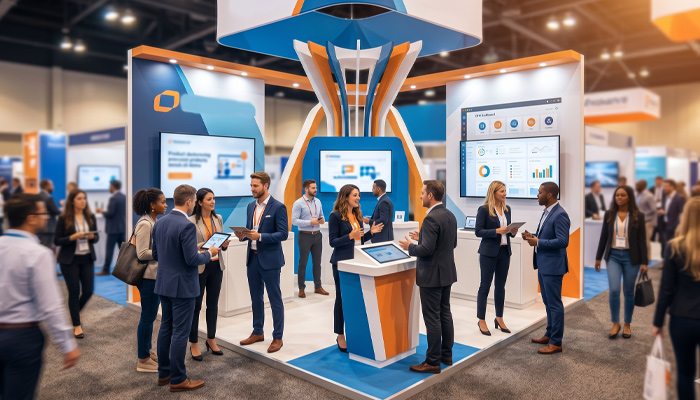
Exhibition marketing is an aggressive B2B sales acquisition strategy that compresses a standard six-month enterprise sales cycle into a 48-hour window by physically intercepting high-intent buyers. Generating a measurable, 10X return on investment (ROI) from trade shows requires entirely abandoning passive brand awareness in favor of a strict, three-phase revenue engine: securing at least 50% of your sales meetings before the event doors open, executing rapid 30-second lead qualification on the floor using experiential design, and triggering automated CRM follow-ups within 48 hours to aggressively close the pipeline.

Introduction: How to Avoid Turning Trade Shows into “Expensive Corporate Holidays”
Most companies lose tens of thousands of dollars on exhibition marketing because they treat it as a mandatory annual tradition rather than a measurable sales funnel. If your sales and marketing teams return from a three-day expo with a fishbowl full of random business cards, no qualified pipeline, and zero actionable data, you haven’t executed a strategy—you’ve simply funded an expensive corporate holiday.
Achieving a tangible Exhibition ROI requires abandoning the outdated “set up a booth and hope they stop by” mentality. In high-performing B2B event marketing, 80% of your success is determined before you even step foot on the exhibition floor. It is not just about brand visibility; it is a rigorous, 360-degree revenue operation.
To dominate trade show marketing and outperform competitors who are just there to “show their face,” you must align three critical phases:
-
Pre-Show Architecture: Targeting high-value prospects and locking in qualified meetings weeks in advance.
-
On-Site Execution: Utilizing experiential marketing to capture deep, intent-based data rather than just scanning badges. Whether you manage the floor internally or utilize an Expo Concierge to handle logistics and attendee flow, your primary focus must be real-time lead qualification.
-
Post-Show Continuity: Relying on immediate CRM integration to trigger automated, personalized follow-ups before your competitors even board their flights home.
Successful event marketing bridges the gap between physical interactions and digital sales pipelines. This guide dismantles the traditional, flawed approach to exhibitions and replaces it with an aggressive, ROI-driven framework designed to turn foot traffic into closed-won revenue.
What is Exhibition Marketing?
Exhibition marketing is the strategic execution of promoting a brand, product, or service within a multi-vendor trade show environment to capture high-intent leads and drive immediate sales velocity. It involves deploying physical architecture—such as targeted booth design—and operational systems to intercept active buyers who are comparing solutions on a shared exhibition floor.
While the terms are often used interchangeably, exhibition marketing is a highly specialized subset of B2B event marketing. The critical distinction lies in the competitive environment and audience control. When you host a corporate summit or a webinar (general event marketing), you own the audience’s undivided attention. At a trade show, you are engaged in an active battle for seconds of attention against hundreds of competitors operating under the exact same roof.
To clarify the operational differences, here is how the two approaches diverge:
| Strategic Element | Exhibition Marketing (Trade Shows/Expos) | General Event Marketing (Owned Events) |
| Audience Environment | Shared, highly competitive, and distraction-heavy. | Controlled, proprietary, and completely brand-focused. |
| Primary Objective | Rapid lead generation, competitor comparison, and pipeline acceleration. | Brand loyalty, deep educational engagement, and customer retention. |
| Execution Focus | Experiential marketing to stop foot traffic, rapid qualification, and fast data capture. | Sustained narrative control, keynote presentations, and long-form networking. |
Success in this arena relies not on passive brand awareness, but on your ability to deploy a highly tuned inbound and outbound strategy within a condensed, high-stakes timeframe.
Why It Still Rules in the Digital Age
Live trade shows dominate B2B marketing budgets because they bypass digital ad fatigue and compress the entire sales cycle—from discovery to final negotiation—into a 48-hour window. While digital campaigns rely on algorithms to guess buyer intent, exhibitions gather thousands of self-qualified buyers with active budgets under one roof. This environment forces immediate, multi-sensory buyer engagement that simply cannot be replicated through screens.
Power of face-to-face trust building
In-person interactions trigger psychological trust signals and immediate rapport that digital channels cannot achieve. A focused, five-minute conversation on the exhibition floor allows your sales engineers to read body language, handle complex objections in real-time, and validate your company’s credibility through physical presence. High-ticket B2B buyers commit to multi-figure contracts based on confidence in the people behind the product. By deploying experiential marketing tactics within your space, you transform an abstract digital pitch into a tangible, memorable relationship that drastically shortens the time-to-close.
Generating high-intent, warm leads
Exhibition attendees are not passive scrollers; they are active buyers walking the floor specifically to evaluate vendors and solve immediate operational pain points. Consequently, lead generation at a trade show yields a drastically higher closing velocity compared to inbound web traffic.
To maximize this advantage, flawless CRM integration is mandatory. When you capture a lead on the floor, your system must immediately categorize them by purchasing timeline and budget, allowing your sales team to strike while the intent is highest.
| Metric | Digital Inbound Leads | Exhibition/Trade Show Leads |
| Buyer Intent | Low to Medium (Research phase) | High (Active comparison phase) |
| Sales Cycle Speed | 3 to 6+ months | Weeks to a few months |
| Conversion Rate | Industry average (Often < 3%) | Significantly higher due to pre-qualification |
Brand awareness and competitor analysis
Exhibiting instantly validates your brand as an active, financially stable market leader while providing an unfiltered, real-time intelligence gathering operation on your direct rivals. You gain immediate access to your competitors’ newest product releases, sales pitches, and booth design strategies without relying on delayed market reports. Instead of guessing what the market wants, your team can physically observe which competitor narratives are successfully capturing foot traffic, allowing you to adapt your own B2B event marketing positioning on the spot to intercept those exact buyers.
The 3-Step Exhibition Roadmap (The 10X Core)
A 10X exhibition return requires splitting your total budget and bandwidth across three distinct phases: 40% on pre-show meeting generation, 20% on on-site data capture, and 40% on rapid post-show conversion. Most companies fail because they dump 90% of their resources into the physical booth and treat the pre- and post-show phases as afterthoughts. This roadmap transforms your physical footprint into a measurable pipeline engine.
Pre-Show: SMART goals, email invites, dedicated landing pages
Secure at least 50% of your on-site sales meetings before the trade show doors even open. Relying purely on walk-up traffic leaves your ROI entirely to chance. Start by establishing strict SMART goals—for example, “Schedule 40 qualified product demos and generate $500,000 in new pipeline by the end of Q3.”
Execute an aggressive outreach campaign 4 to 6 weeks prior to the event. Segment your CRM and send highly targeted email invites to active prospects, current clients, and registered attendees. Drive this traffic to a dedicated, event-specific landing page. This page should not just say “Visit us at Booth #402”; it must offer a tangible incentive for booking a meeting in advance, such as a free technical audit, exclusive industry data, or access to a private networking dinner.
During-Show: Experiential booth design, staff pitch training, digital lead capture (QR/Tablets)
Your on-site footprint must function as a high-speed qualification engine, designed to filter out tire-kickers and capture active buyers within three minutes. Deploy experiential booth design that visually communicates exactly what problem you solve the moment an attendee walks down the aisle—ditch the generic corporate jargon on your backdrops in favor of clear, disruptive value propositions.
Booth staff require rigorous, scenario-based pitch training. Their objective is not to close a complex B2B deal on the trade show floor; their job is to execute a 30-second qualification pitch to determine the prospect’s budget, authority, and timeline.
Simultaneously, completely eliminate manual data entry. Utilize digital lead capture via integrated tablets or dynamic QR codes. When a badge is scanned, your staff must instantly add qualitative notes (e.g., “Needs a solution for server latency by October”) directly into the capture app, ensuring the lead isn’t just a name, but an actionable profile.
Post-Show: The 48-hour follow-up rule and CRM email automation (The most crucial step)
If a lead does not receive a personalized response within 48 hours of the event ending, their conversion probability drops by over 80%. The post-show phase is where your exhibition ROI is ultimately won or lost. Do not wait for the marketing team to manually untangle and clean spreadsheets a week after the event.
The secret to a 10X strategy is building your post-show CRM email automation before you travel to the venue. Create segmented email templates based on the specific conversations had on the floor. When your team tags a lead as “Hot – Tier 1” via their tablets on Tuesday, your CRM should automatically trigger a personalized email from the respective sales rep by Wednesday morning, moving the prospect directly to the next stage of the pipeline.
| Follow-up Element | Traditional (The “Corporate Holiday” Approach) | The 10X ROI Approach |
| Timing | 1 to 2 weeks post-event | Under 48 hours (Automated) |
| Message | “Thanks for stopping by our booth!” (Generic blast) | “Here is the specific case study we discussed regarding [Pain Point].” |
| Data Handoff | Manual CSV upload prone to human error | Instant CRM integration straight from the show floor |
| Next Step | Waiting for the prospect to reply | Direct calendar link provided for a formal discovery call |
How to Calculate Exhibition ROI: Formula, Cost Per Lead (CPL), and Key KPIs
Exhibition ROI is determined by a strict mathematical formula:
[(Gross Profit from Exhibition Leads – Total Exhibition Costs) / Total Exhibition Costs] x 100.
Stop relying on vanity metrics like “booth traffic,” “swag distributed,” or “brand impressions.” In high-level B2B event marketing, a successful trade show is measured exclusively by pipeline acceleration, closed-won revenue, and the financial efficiency of acquiring those contracts.
To calculate your true Total Exhibition Costs, you must look far beyond the invoice for the venue floor space. Your calculation must include booth design and fabrication, union labor, travel and accommodation, shipping and drayage, promotional collateral, internet drops, and the daily salary cost of your staff operating the booth instead of working their standard territories.
Cost Per Lead (CPL) in Trade Show Marketing
Your Cost Per Lead (CPL) dictates whether an exhibition is a financially viable acquisition channel compared to your digital campaigns. Calculate it directly: Total Exhibition Costs / Number of Qualified Leads.
The critical mistake most event managers make is dividing their budget by total badge scans. A badge scan is just a data point; a lead is a prospect with Budget, Authority, Need, and Timeline (BANT). If you spend $60,000 on an event and scan 600 badges, but only 40 are actual buyers, your true CPL is $1,500—not $100. You must optimize your on-site strategy to drive that $1,500 down while keeping the lead quality exceptionally high.
The Non-Negotiable Event KPIs
To evaluate your exhibition marketing performance objectively, you must track these specific indicators over a 6-to-12-month window post-event:
| Key Performance Indicator (KPI) | Formula / Measurement | The “10X” Insight (Why It Matters) |
| Sales Conversion Rate | (Closed Deals / Total Qualified Leads) × 100 | Exposes the quality of your booth staff’s conversations. High scans but low conversion means your team pitched poorly. |
| Pipeline Velocity | Average days from initial badge scan to a closed-won contract. | Trade show leads should close much faster than cold outbound. If they stall, your post-show follow-up is broken. |
| Cost Per Acquisition (CPA) | Total Exhibition Costs / Number of Closed Deals | The ultimate truth-teller. If your CPA here is higher than a customer’s Lifetime Value (LTV), drop the event. |
Relying on accurate CRM integration is the only way to track these metrics. When a deal closes eight months after the exhibition, your CRM must attribute that revenue back to the specific event campaign, giving you the undeniable data needed to justify next year’s budget.
5 Fatal Exhibition Mistakes: No clear goals, cluttered booths, untrained staff, ignoring follow-ups
Exhibitions fail and budgets burn because companies treat trade shows like static billboards rather than active outbound sales channels. When your B2B event marketing strategy lacks structural discipline, your return on investment plummets to zero. Here are the five critical errors that sabotage trade show success and how to eliminate them:
1. Operating Without Measurable Revenue Goals Showing up to “build brand awareness” is a financial death sentence. Without setting definitive, revenue-driven targets—such as securing 30 pre-scheduled meetings, generating $200k in qualified pipeline, or capturing 50 high-intent leads—your team has no operational benchmark. Vague goals result in passive, unmeasurable execution.
2. Designing a Cluttered, Information-Heavy Booth Your booth is an interception tool, not a corporate brochure. Flooding your backdrops with bullet points, exhaustive product specifications, and complex diagrams repels attendees walking the aisles. Effective experiential design dictates that your architecture must communicate the primary problem you solve in under three seconds using bold, minimalist visuals and a single, disruptive hook.
3. Deploying Untrained, Passive Staff Placing account executives or product engineers on the floor without specific trade show pitch training guarantees lost opportunities. Staff usually fall into two fatal traps: standing passively like security guards waiting for walk-ups, or immediately trapping attendees in a 15-minute product monologue. Booth staff must be trained to execute a rapid, 30-second qualification loop to quickly assess if an attendee is an active buyer or a time-waster.
4. Ignoring Immediate Post-Show Follow-Ups The absolute costliest mistake in exhibition marketing is treating the follow-up as a low-priority task for “when we get back to the office.” If your lead data sits in a fishbowl or an unformatted spreadsheet while your competitors execute automated CRM workflows, you will lose the deal. A buyer’s intent decays exponentially every 24 hours after they leave the show floor.
5. Managing Floor Logistics Instead of Selling Your top sales reps should never be distracted by restocking brochures, troubleshooting tablet Wi-Fi, or directing unqualified foot traffic. High-performing teams separate logistics from sales by utilizing a dedicated floor manager or an Expo Concierge to handle on-site friction. This ensures your closers remain 100% focused on what matters: executing high-value, face-to-face conversations.
| Fatal Mistake | The Immediate “10X” Fix |
| “Brand Awareness” Focus | Set strict, pipeline-driven KPIs (e.g., 50 Qualified Demos Booked). |
| Cluttered Visuals | Deploy a 3-second, single-message experiential hook. |
| Passive/Untrained Staff | Train staff strictly on 30-second rapid BANT qualification. |
| Delayed Lead Follow-Up | Trigger CRM-integrated emails within a maximum of 48 hours. |
| Distracted Sales Reps | Delegate all floor logistics to an event manager or Expo Concierge. |
Conclusion
Exhibition marketing is a high-stakes, time-compressed revenue engine, not a passive brand awareness exercise. Shifting from a traditional booth presence to a 360-degree, ROI-driven strategy transforms trade shows from corporate expenses into highly predictable sales pipelines. By locking in pre-show meetings, executing rapid on-site qualification through experiential design, and enforcing strict 48-hour CRM follow-ups, your B2B event marketing outpaces competitors who are simply there to collect business cards. The ultimate metric of trade show success is closed-won revenue—every tactical decision, from pre-event emails to on-site data capture, must serve that singular financial goal.
Frequently Asked Questions (FAQs)
1. How do I justify the high cost of exhibition marketing to my executive team?
Shift the focus entirely from vanity metrics (badge scans, booth traffic) to projected Pipeline Velocity and Cost Per Acquisition (CPA). Present a clear strategy where 50% of sales meetings are booked pre-show, guaranteeing a measurable baseline return on investment before the event even begins.
2. What is the ideal timeline for planning a B2B trade show?
Execution must begin 6 to 9 months in advance. Structural architecture and logistics require 3 to 4 months to finalize, while the critical pre-show outreach and meeting generation campaigns must launch at least 4 to 6 weeks prior to the event doors opening.
3. How can our brand stand out on a crowded exhibition floor?
Deploy experiential marketing rather than corporate brochures. Ditch text-heavy backdrops for a single, disruptive visual hook that communicates your core value proposition and solves a specific pain point in under three seconds.
4. What is the most efficient way to capture lead data on-site?
Completely eliminate paper business cards and manual data entry. Utilize CRM-integrated tablets or dynamic QR scanners that allow your staff to instantly input rapid qualification notes (Budget, Authority, Need, Timeline) alongside the prospect’s contact information for immediate routing.
5. Should our top sales executives manage the trade show booth?
Your top closers must focus 100% on high-value, face-to-face negotiations, not troubleshooting logistics. Utilize an Expo Concierge or a dedicated floor manager to handle technical issues, restock materials, and filter unqualified foot traffic away from your sales team.


