

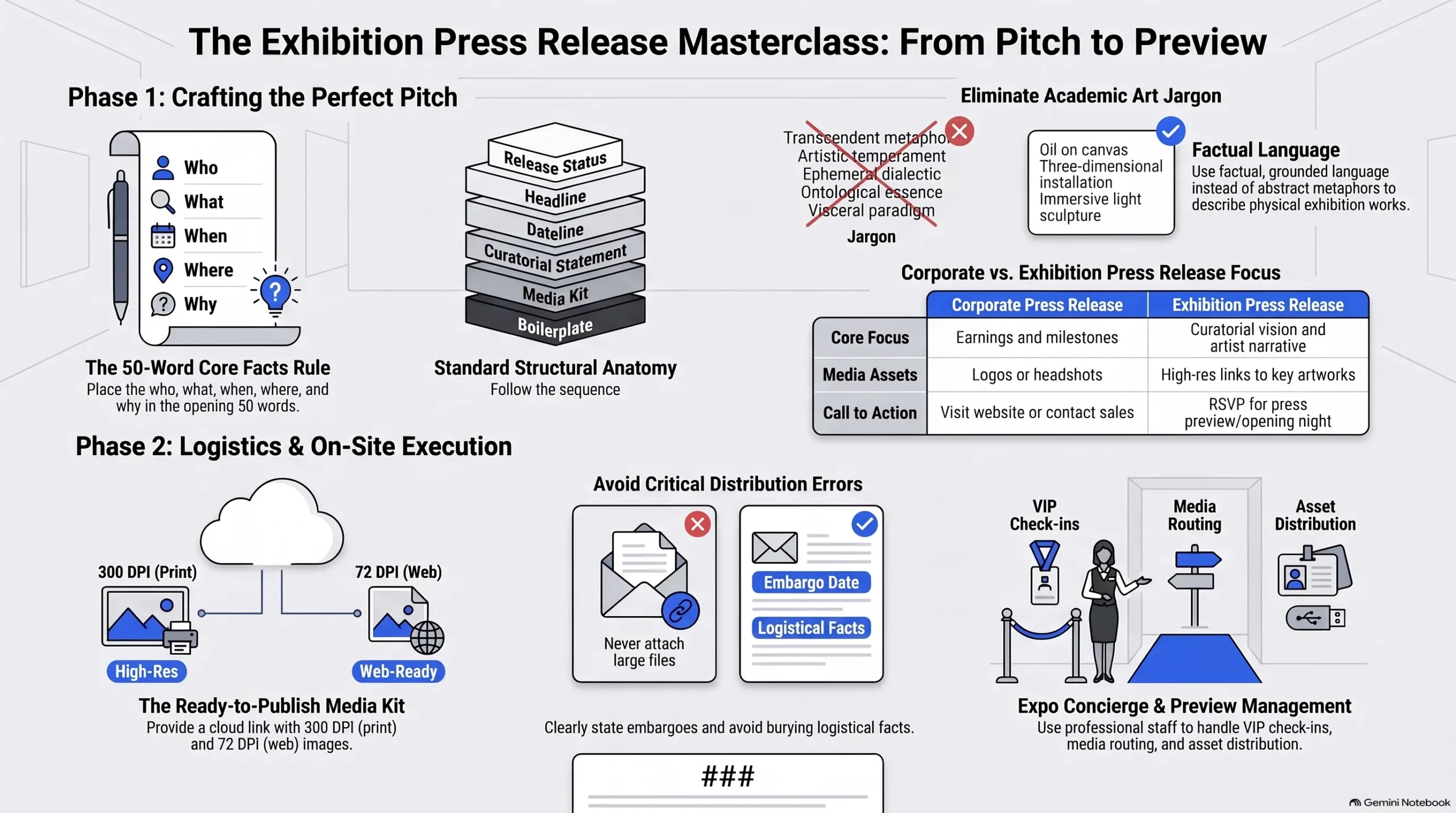
A successful exhibition press release must deliver essential event details—including the featured artist, public run dates, venue location, and a direct cloud link to high-resolution media assets—within the first 50 words. Because art editors and journalists process dozens of daily pitches under tight editorial deadlines, submissions laden with dense academic jargon or hidden logistics are discarded immediately. Structuring the announcement around verified facts, standardized embargo terms, and accessible visual assets ensures seamless media coverage and effective on-site PR management.
Introduction & The Reality of Exhibition PR
Journalists and art editors delete roughly 90% of exhibition press emails they receive without reading past the subject line. To secure media coverage and foot traffic for an upcoming art show, your press release must deliver the core facts—who, what, when, where, and why—in the first 50 words, supported by a scannable layout, a high-resolution image link, and a clear embargo date.
Vague art terminology and dense curatorial statements bury your most important details. Reporters operate on tight deadlines and zero patience for decoding complex abstracts. They want a factual press dossier they can quickly verify and translate into their editorial calendars.
The vast majority of journalists (73%) receive up to 50 pitches per week, and half say they reject pitches simply because they are irrelevant or badly timed. Direct, concise emails with clear multimedia assets are the baseline for getting a response.
Source: Muck Rack
This guide bypasses abstract advice and provides the exact mechanics of a successful media pitch. You will find copy-paste templates, strict formatting breakdowns, and real-world examples from top-tier institutions like the Van Gogh Museum. Whether you are an independent artist, a gallery owner, or handling expo management for a major venue, applying these strategies ensures your press preview and main event attract the right critics and crowds.
What Makes an Exhibition Press Release Different?
A standard corporate press release announces financial milestones or product launches, whereas an exhibition press release sells a physical, visual experience. Art editors evaluate pitches based on the availability of high-resolution visual assets, a clear curatorial statement, and specific logistics for the press preview and opening night.
Reporters covering a corporate announcement might just rewrite the provided text, but an art critic needs to understand the thematic anchor of your contemporary art exhibition before they commit to attending. They expect a structured press dossier that bridges the gap between the logistical facts of the expo management and the creative intent of the artist.
| Element | Corporate Press Release | Exhibition Press Release |
|---|---|---|
| Core Focus | Earnings, mergers, or new service features. | Curatorial vision, cultural relevance, and artist narrative. |
| Media Assets | Company logo or a basic headshot of an executive. | Cleared, high-resolution image link showcasing key artworks. |
| Call to Action | Visit the company website or contact sales. | RSVP for the press preview or exclusive opening night. |
Your media kit must provide immediate access to the art itself. Editors will not reply to your email asking for pictures; if the images are missing, they simply move to the next pitch. Include a link to a cloud folder containing both web-ready and print-ready files, complete with caption sheets detailing the artist name, title, year, medium, and dimensions.
Event logistics also play a heavier role in art gallery PR than in standard business announcements. You must clearly state the embargo date, public run dates, and exact times for media-only viewings. By presenting these elements plainly and avoiding heavy art jargon, you allow journalists to quickly file the event in their editorial calendars.
The Anatomy of a Perfect Exhibition Press Release
| Press Release Element | Formatting & Guidelines | Core Objective | Best Practice / Execution |
|---|---|---|---|
| 1. FOR IMMEDIATE RELEASE & Headline | All caps at top margin; headline under 100 characters using title case without exclamation marks. | Signals immediate clearance or embargo date and provides a factual summary of the news. | Strong: “Singapore Art Museum Announces Retrospective on Southeast Asian Textile Art.” |
| 2. Dateline & The 5 Ws | Formatted as CITY, State—Month Day, Year; opening paragraph kept strictly under 50 words. | Answers who, what, when, where, and why immediately for rapid editorial listing. | Deliver pure logistical facts without including venue history or abstract interpretations. |
| 3. Curatorial Statement & Quotes | Spans 2nd & 3rd paragraphs; includes exactly one short quote from the artist or curator. | Translates academic art theory into plain English and adds a human perspective. | Keep language grounded and avoid heavy theoretical terms that alienate the general public. |
| 4. Media Kit & High-Res Images | Hyperlinked cloud folder with 300 DPI (print) and 72 DPI (digital) images plus artwork credit PDF. | Bypasses spam filters, avoids full inboxes, and increases engagement by up to 552%. | Never attach heavy image files directly to the pitch email; always use external storage links. |
A standard exhibition press release operates on a rigid, universally expected framework: release status, headline, dateline, the 5 Ws, supporting curatorial context, a media kit link, and contact details. This structural conformity exists to help journalists extract and verify facts in seconds. Deviating into highly customized layouts or burying details under blocks of text will get your pitch discarded.
1. FOR IMMEDIATE RELEASE & The Headline
Type “FOR IMMEDIATE RELEASE” in all capital letters at the top margin of your document to signal the information is cleared for public consumption. If the information is restricted until a certain date, write “UNDER EMBARGO UNTIL [Date/Time].”
Your headline must act as a factual summary rather than an advertising slogan. Keep it under 100 characters, use title case, and avoid exclamation marks. Art critics want to know exactly what the email is about before they open it.
- Poor Headline: An Incredible New Journey Through Color!
- Strong Headline: Singapore Art Museum Announces Retrospective on Southeast Asian Textile Art.
2. The Dateline & The 5 Ws
The dateline establishes the origin and timing of the news, formatted as CITY, State—Month Day, Year. The opening paragraph immediately follows this and answers who is exhibiting, what the show is, when it opens, where it is located, and why it matters. Keep this introductory paragraph under 50 words.
Do not include the history of your venue or abstract interpretations in this section. If a reporter only reads this single paragraph, they should have every logistical detail needed to publish a brief event listing.
3. The Curatorial Statement & Quotes
The second and third paragraphs translate the academic framework of the show into accessible language. Explain the thematic focus, the artist’s primary medium, and the cultural relevance of the body of work.
Include exactly one short, impactful quote from the artist, head curator, or organizer. Editors use this quote to add perspective and a human element to their articles without needing to conduct a full interview. Keep the language grounded and avoid heavy theoretical terms that alienate the general public.
4. The Media Kit & High-Res Images
Insert a direct hyperlink to a cloud storage folder containing your visual assets. This folder must hold 300 DPI images for print publications, 72 DPI images for digital use, and a clear PDF document listing all artwork credits (Artist, Title, Year, Medium, Dimensions).
Attaching large image files directly to your email pitch triggers spam filters and fills up a reporter’s inbox. Always use an external link.
Including multimedia elements like high-resolution photos and videos in your press release can increase your content’s visibility and engagement by up to 552%. Visual assets make the story more compelling and ready to publish.
Source: PR Newswire
5. The Boilerplate & Media Contact
The boilerplate sits at the bottom of the document and serves as a factual, reusable summary of your gallery or organization’s history and mission. It functions exactly like an “About Us” section.
Beneath the boilerplate, provide the designated press contact’s full name, email address, and direct phone number. If you are hosting a press preview, clearly state the RSVP instructions and deadline just above the contact information. Finally, mark the absolute end of the document by centering three pound signs (###) at the bottom of the page.
Which part of the press release format do you find most challenging to write?
Real Examples: Analyzing Top Museum Press Releases
Top-tier institutions secure media coverage by stripping emotion and subjective interpretation from their media pitches, presenting only verified exhibition dates, artist milestones, and high-resolution media links in the opening paragraph. A structural analysis of press releases from the Van Gogh Museum and Kunstmuseum Den Haag reveals that they use standardized scannable layouts, bulleted logistical facts, and clear embargo dates rather than elaborate curatorial theory.
Case Study: Van Gogh Museum & Kunstmuseum
The Van Gogh Museum’s press releases lead immediately with the core logistical facts and the significance of the artist, isolating subjective commentary to a single blockquote. For example, their announcements regarding major exhibitions like the Anselm Kiefer showcase or The Power of Pigments place the exhibition title, public run dates, and exact opening location within the first 40 words. By moving the curatorial context to the third paragraph, the museum allows journalists to extract the necessary facts for their editorial calendars instantly without reading the entire document.
Kunstmuseum Den Haag structures its fashion and contemporary art announcements, such as their Reflections on Fashion exhibition, with identical precision. Their media team uses distinct subheadings to separate the historical background of the exhibited pieces from the practical details like ticketing and press preview dates. This clean formatting ensures art editors can quickly scan the document to locate the exact information required for publication.
| Element | Van Gogh Museum Approach | Kunstmuseum Approach |
|---|---|---|
| Opening Paragraph | Exhibition dates, core artist, and venue location. | Immediate theme identification and opening date. |
| Use of Quotes | One concise statement from the museum director. | Single quote highlighting cultural relevance. |
| Media Assets | Direct hyperlink to approved imagery. | Embedded links to downloadable press folders. |
Both museums strictly avoid promotional language and abstract art terminology in their opening statements. They present their exhibitions as newsworthy cultural events using direct, factual sentences. This approach treats the press release as a functional tool for reporters rather than a marketing flyer for the general public.
[Template] Free Exhibition Press Release Framework
Copy and paste the text below directly into your word processor to draft your announcement. Replace the bracketed information with your specific event details, keeping the structural sequence exactly as outlined to meet standard journalistic expectations.
FOR IMMEDIATE RELEASE [or UNDER EMBARGO UNTIL Month, Date, Year]
Headline: [Institution Name] Announces [Exhibition Title], Featuring Works by [Artist Name]
[CITY, State/Country] — [Month, Date, Year] — On [Date], [Gallery/Institution Name] will open [Exhibition Title], a [solo/group] exhibition showcasing [number] works by [Artist Name]. Running through [End Date], the presentation highlights [primary theme, e.g., post-war abstract expressionism] and marks the artist’s [first/largest/recent] showing in [Location].
[Exhibition Title] examines [Core Theme]. The collection features [specific type of art, e.g., large-scale bronze sculptures or multimedia installations] that address [briefly state the artistic concept without dense jargon]. Key pieces on display include [Name of Artwork 1, Year] and [Name of Artwork 2, Year].
“[Insert a one- to two-sentence quote from the artist or head curator explaining the intent behind the collection in plain English],” says [Name, Title].
Event Logistics & Media Assets:
- Press Preview: [Date, Time]. RSVP to [Email] by [Date].
- Public Opening: [Date, Time].
- General Admission: [Ticket Price / Free Entry], [Operating Hours].
- Media Kit (High-Res Images & Caption Sheet): [Insert Hyperlink]
About [Gallery/Institution Name]:
[Institution Name] is a [Location]-based art space dedicated to [Mission Statement/Focus]. Founded in [Year], the gallery presents [type of programming].
Media Contact:
[Full Name], [Title]
[Email Address]
[Phone Number]
###
Are you planning to host a dedicated press preview before the public opening, or will media attend the main event?
5 Common Mistakes That Ruin Art & Expo Pitches
Art promoters ruin their media pitches by writing dense academic jargon, hiding event dates at the bottom of the email, and attaching massive image files that trigger journalist spam filters. Reporters discard these submissions instantly, opting instead for press dossiers that respect their strict deadlines and inbox storage limits.
1. Writing in Academic Art Jargon
Many curators draft releases using theoretical, inaccessible language that actively alienates readers. Reporters do not want to decode abstract concepts about spatial relativity or metaphysical boundaries just to understand the theme of the show. They require clear, factual sentences that explain exactly what physical objects visitors will see in the gallery space.
2. Burying the Hard Logistics
Placing the opening date, ticket prices, and physical address at the very end of a two-page document guarantees lost coverage. Editors scan the first paragraph specifically to check if the event aligns with their upcoming publishing schedule. If the run dates are missing or hidden behind lengthy paragraphs of artist biography, the pitch is rejected immediately.
3. Attaching Massive Image Files
Sending a 25MB email with raw photo files attached directly to the message will send the pitch straight to the spam folder. Journalists despise bulky attachments that slow down their email clients. Always use a plain text hyperlink directing the reader to a well-organized external cloud folder containing your visual assets.
4. Vague or Missing Embargo Directives
Sending a document without clear publication instructions creates unnecessary friction. If an editor does not know whether they can publish the story today or if they must wait for the official media viewing, they will often ignore the email entirely. State your release terms plainly at the very top margin of the page.
5. Failing to Tailor the Local Hook
Sending the exact same angle to a neighborhood culture blogger and a broadsheet critic rarely works. National writers care about industry trends and major curatorial milestones, while local reporters focus on community impact and weekend accessibility. Failing to adjust the opening hook makes your pitch feel like an automated mass broadcast.
Which of these structural mistakes have you found hardest to avoid when drafting your own gallery announcements?
Beyond the Press Release: Preparing for the Media on Opening Night
Securing a journalist’s RSVP is only half the job; executing a flawless on-site media experience determines whether they actually publish a favorable review. When art critics and editors arrive at your gallery, they expect immediate access to the lead curator, a physical press dossier, and an unobstructed environment to view the collection.
If a reporter spends twenty minutes waiting in a chaotic check-in line or cannot locate the designated spokesperson, their perception of the show sours before they even see the artwork. A well-managed preview requires dedicated floor staff capable of identifying arriving media personnel, distributing press badges, and facilitating timed tours without disrupting the general public or potential buyers.
Elevate Your Event with an Expo Concierge
Hiring an Expo Concierge guarantees that your media guests and high-profile collectors receive dedicated, professional attention while you focus entirely on the exhibition and networking. A specialized concierge handles the entire front-of-house operation, from cross-referencing VIP guest lists to guiding critics directly to key installations.
Managing an art show requires organizers to engage with buyers and artists, not troubleshoot coat checks or track down missing information packets. Integrating professional expo management staff eliminates logistical friction on the floor. The concierge acts as the definitive first point of contact, ensuring every reporter who responded to your media pitch is greeted promptly and provided with the exact context needed for their editorial piece.
- VIP Check-in: Seamlessly process arriving media members and high-net-worth collectors without making them wait in general admission lines.
- Press Asset Distribution: Hand out physical media kits, thumb drives with high-resolution image links, and finalized curatorial statements.
- Media Routing: Escort specific journalists directly to the artists or head organizers for pre-scheduled brief interviews.
Stop worrying about front-door logistics and start focusing on the success of your exhibition. Ensure your next gallery opening or trade event runs perfectly by booking professional on-site support through our Expo Concierge services today.
Conclusion & Next Steps
A successful media pitch delivers the who, what, when, where, and why of your event in the first 50 words, paired with a direct link to high-resolution visual assets. Securing coverage requires abandoning academic art terminology in favor of a factual, scannable document that respects a journalist’s time and editorial schedule.
Before distributing your pitch, verify that your press folder is fully accessible via a cloud link and contains both web-ready and print-ready images. Editors will delete the email if the release dates are ambiguous or if the artwork caption sheets are missing from the shared drive.
Once the media commits to attending, your operational focus must shift to the venue floor. Use the copy-paste format provided in this guide to draft your announcement today. For the opening event itself, book our Expo Concierge services to manage VIP check-ins, media routing, and front-of-house logistics so you can focus entirely on your artists and collectors.
What is the date of your upcoming exhibition, and how many journalists are on your target media list?
Frequently Asked Questions
How long should an exhibition press release be?
An exhibition press release should be between 300 to 500 words. If you are printing physical copies for a physical press dossier, keep the text strictly to a single page.
When should I send a press release for an upcoming exhibition?
Send your initial media pitch three to four weeks before the exhibition opens. Send a short follow-up email exactly three days before the opening night or scheduled press preview.
Do I need to include images in the press release email?
Never attach large image files directly to your email. Always provide a clear hyperlink to a cloud-based media kit containing high-resolution images, artwork captions, and artist biographies.
What is an exhibition press preview?
A press preview is an exclusive, invite-only viewing of the exhibition for journalists, art critics, and media professionals before the doors open to the general public.


