

The Maritime Industry 2025 exhibition, held in Gorinchem, the Netherlands, serves as a premier European platform for the inland shipping and maritime sectors. Organized by Easyfairs, this highly targeted trade fair brought together 350 international exhibitors and 7,000 key decision-makers to explore cutting-edge advancements in shipbuilding, emission-reduction technologies, and marine propulsion. By integrating smart digital networking and live operational simulations, the event solidifies the Benelux region’s crucial role as a sustainable maritime logistics hub.
| Key Aspect | Detailed Information |
| Event Location & Organizer | Organized by Easyfairs at Evenementenhal Gorinchem, The Netherlands (May 2025). |
| Participation Scale | Hosted approximately 350 international exhibitors and 7,000 targeted industry professionals. |
| Core Technical Sectors | Shipbuilding, marine propulsion, port infrastructure, smart logistics, and sustainability technologies. |
| Digital Infrastructure | Utilized a Smart Badge system for automated, paperless lead generation and digital information delivery. |
| Live Operational Simulations | Featured an indoor artificial water basin with remote-controlled vessel loading and unloading demonstrations. |
| Strategic Logistics Positioning | Capitalizes on the Rhine River network to connect the Benelux corridor, Germany, and France. |
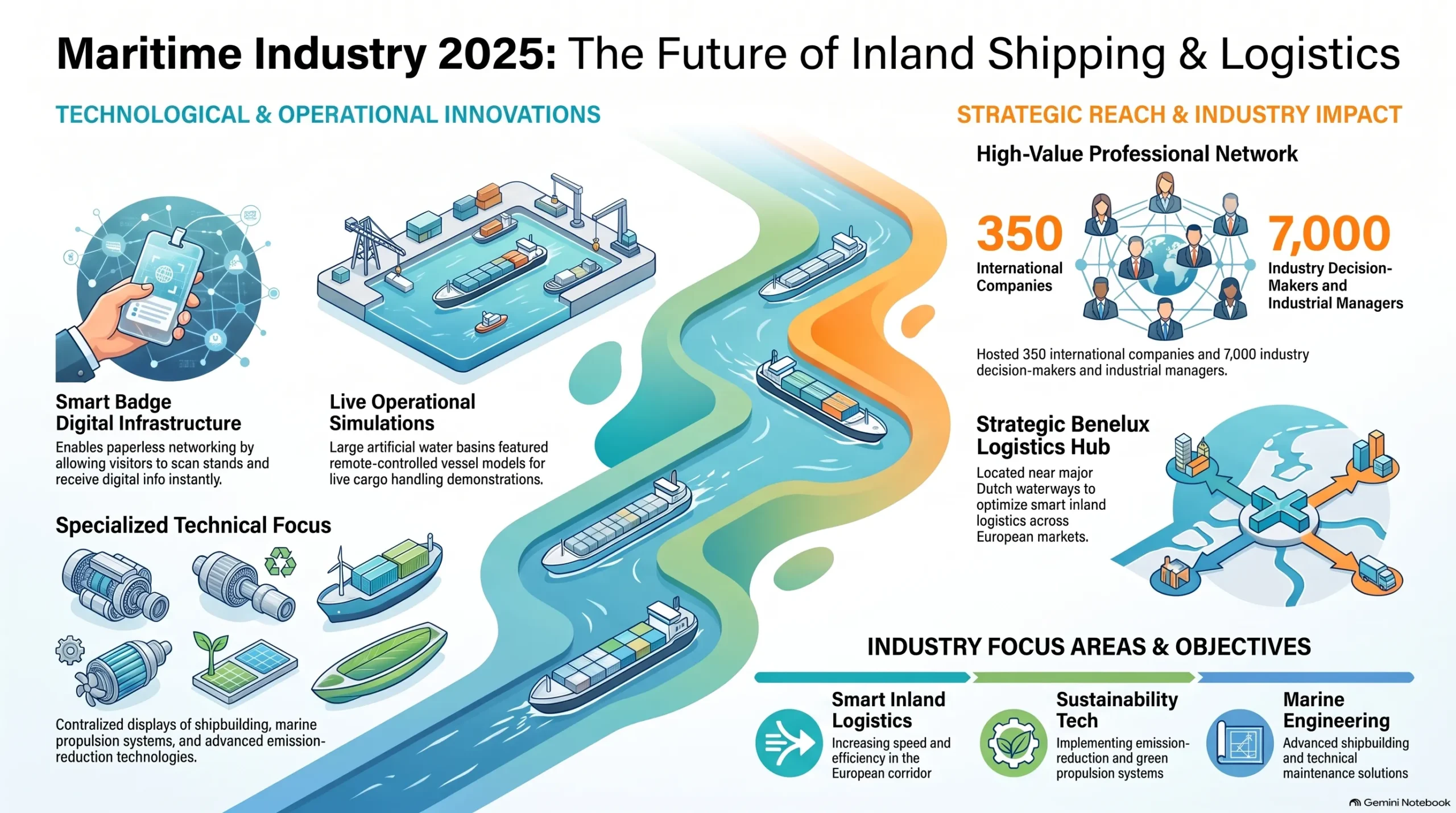
Event Overview and Industry Positioning
Maritime Industry 2025 was held in May 2025 in the city of Gorinchem, the Netherlands. This annual event, organized at the Evenementenhal Gorinchem, is considered one of the most significant specialized exhibitions in the maritime and inland shipping sector within the Benelux region.
The exhibition focuses on industries related to:
Shipbuilding and maintenance
Marine propulsion systems and technical equipment
Port infrastructure
Smart inland logistics solutions
Sustainability and emission-reduction technologies
The event is organized by Easyfairs, a company with extensive experience in hosting specialized trade fairs across Europe. In the 2025 edition, approximately 350 companies from various countries participated, and according to official statistics, around 7,000 professionals, industrial managers, suppliers, and decision-makers attended the exhibition.
These figures confirm that Maritime Industry is not a public consumer event, but a highly targeted and professional platform for maritime industry stakeholders.
Maritime Industry 2025 Exhibition: Key Highlights & Overview
| Category / Key Metric | Event Details |
|---|---|
| Event Name & Date | Maritime Industry 2025 (May 2025) |
| Location & Venue | Evenementenhal Gorinchem, Gorinchem, The Netherlands |
| Organizer | Easyfairs |
| Participation Scale | Approximately 350 international exhibitors and 7,000 industry professionals, managers, and decision-makers |
| Key Technical Sectors |
|
| Digital Infrastructure | Smart Badge system enabling paperless scanning of stands and automated digital info delivery |
| Interactive Highlights | Indoor artificial water basin with live remote-controlled vessel loading and unloading simulations |
| Strategic Context | Serves as a key logistics hub for inland shipping across the Benelux corridor, Germany, Belgium, and France |
Operational Structure and Digital Infrastructure
One of the notable strengths of the exhibition was the digital management of the visitor journey. The Smart Badge system, provided at the entrance, enabled visitors to digitally scan exhibitor stands and automatically receive company information via email.
This system offered several key advantages:
Eliminating the need to collect printed brochures
Direct digital transfer of exhibitor information
Facilitating post-event follow-up
Optimizing the overall visitor experience
Such infrastructure demonstrates the organizer’s understanding of the importance of digitalizing the exhibition experience.
From a geographical perspective, the venue is strategically located. Gorinchem lies close to major Dutch waterways, and the exhibition site is easily accessible by train, bus, and private car. The choice of this city is fully aligned with the identity and operational landscape of the maritime industry.
Implementing advanced networking technologies illustrates how Digital Transformation is fundamentally reshaping the way industry leaders connect and exchange technical data on the exhibition floor.
Interactive Design and Operational Simulation
One of the most prominent features of the exhibition was the installation of a large artificial water basin inside the hall, where scale models of vessels, barges, and marine cranes were displayed.
In this area, loading, unloading, and cargo transfer operations were simulated live through remote-controlled systems.
This design approach offered several distinctive benefits:
Transforming product presentation from static display to real operational demonstration
Enhancing technical understanding of equipment performance
Creating a tangible and immersive experience for industrial decision-makers
Increasing brand memorability among visitors
This approach reflects a broader shift within the maritime sector toward interactive and performance-based presentation models.
Delivering a highly engaging and tangible environment is essential for modern trade fairs, as a well-designed Customer Experience directly influences purchasing decisions and long-term brand loyalty.
Strategic Importance of Maritime Logistics in Europe
The Netherlands is recognized as one of Europe’s primary transport hubs. The Rhine River, which flows from Germany into the Netherlands, is one of the busiest and most strategically important inland waterways in Europe.
Through an extensive network of canals and ports, the river connects directly to international waters, enabling seamless transportation of goods between major European economies and global markets.
The proximity to economically powerful countries such as:
Germany
Belgium
France
has positioned the Benelux region as a strategic logistics corridor within Europe.
Maritime Industry operates precisely within this context — as a platform for technologies that enhance efficiency, safety, sustainability, and speed in inland shipping.
Analytical Conclusion
Maritime Industry 2025 serves as a strategic benchmark for the evolution of inland shipping and maritime logistics across the European Benelux corridor. By combining a highly targeted professional audience, paperless digital visitor management via the Smart Badge system, and interactive live operational demonstrations, the trade fair successfully bridges technical innovation with practical commercial application. For companies, suppliers, and decision-makers aiming to strengthen their market presence in sustainable maritime technologies and European inland waterways, visiting the Maritime Industry Official Platform offers a crucial reference point for industry trends and future network development.
From the perspectives of specialization, operational management, visitor experience design, and performance-oriented product presentation, Maritime Industry 2025 can be evaluated as operating at a high level of European professional standards.
The exhibition demonstrates that:
Smaller, specialized trade fairs can generate deeper and more meaningful industry interactions than broad, general exhibitions.
Digitalization plays a crucial role in increasing exhibition efficiency.
Interactive presentation of industrial equipment represents a competitive advantage, particularly in technical sectors.
The geographical location of an event is an integral component of its industrial strategy.
For companies seeking entry into or expansion within the European inland shipping market, this exhibition represents a focused and strategically relevant access point to the industry ecosystem.
When evaluating marketing budgets for specialized industrial sectors, assessing specific metrics and asking Is Participating in a Trade Show Really Worth the Cost? helps exhibitors maximize their return on investment.
Q1: When and where was the Maritime Industry 2025 exhibition held?
A1: The exhibition was held in May 2025 at the Evenementenhal Gorinchem in the city of Gorinchem, the Netherlands.
Q2: Who organized the event, and what was the scale of participation?
A2: The trade fair was organized by Easyfairs. The 2025 edition featured approximately 350 participating companies and attracted around 7,000 industry professionals, managers, suppliers, and decision-makers.
Q3: What key sectors and technical solutions were showcased at the exhibition?
A3: The event focused on five primary areas: shipbuilding and maintenance, marine propulsion systems, port infrastructure, smart inland logistics solutions, and sustainability and emission-reduction technologies.
Q4: How did the Smart Badge digital system work for visitors?
A4: Visitors received a Smart Badge at the entrance that enabled them to digitally scan exhibitor stands and automatically receive company information via email, eliminating the need to collect printed paper brochures.
Q5: How were vessel operations demonstrated inside the exhibition hall?
A5: A large artificial water basin was installed inside the hall featuring scale models of vessels, barges, and marine cranes, where loading, unloading, and cargo transfer operations were simulated live using remote-controlled systems.


