

Participating in a B2B trade show is a strategic, long-term investment focused on building lasting business relationships rather than generating immediate on-site sales. By allocating a structured budget and executing a disciplined follow-up strategy, companies can successfully navigate lengthy purchasing cycles. Ultimately, this approach maximizes return on investment, secures high-value contracts, and establishes strong market credibility for your brand.
| Post-Event Phase | Expected Timeline | Primary Objective & Strategy | Key Outcomes |
| Initial Engagement | 1 to 3 Months | Conduct initial follow-ups and schedule introductory meetings with leads. | Filtering prospects and establishing a direct line of communication. |
| Active Negotiation | 3 to 6 Months | Present detailed proposals, address technical evaluations, and negotiate terms. | Moving prospects through the sales funnel toward formal agreements. |
| Finalization & Partnership | 6 to 12+ Months | Secure internal corporate approvals and finalize large industrial contracts. | Securing long-term business partnerships and achieving a positive ROI. |
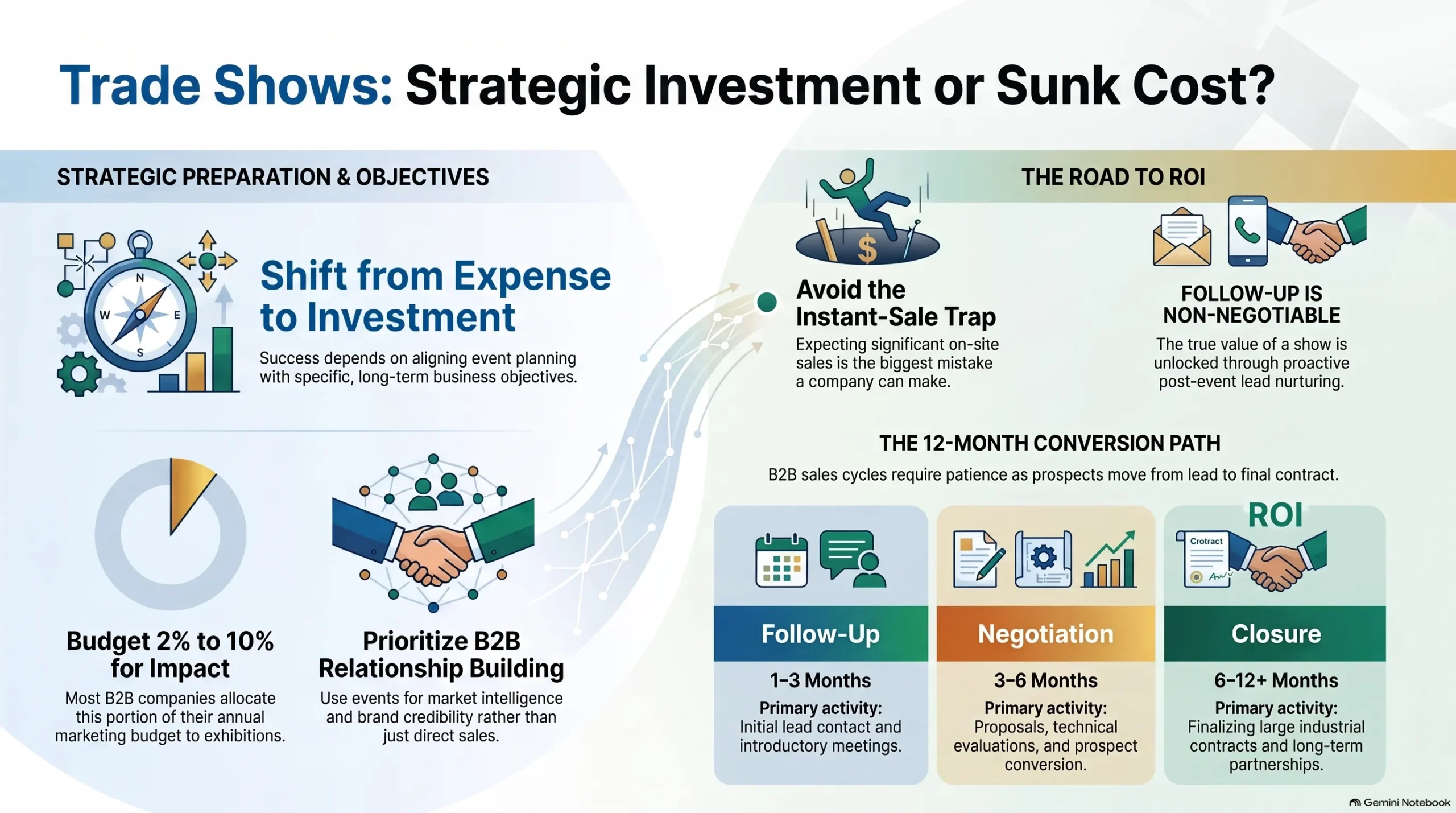
Why Participate in a Trade Show?
Many people assume that the primary purpose of attending a trade show is to generate direct sales. However, the reality is that professional exhibitions—especially in B2B markets—are, above all, platforms for building business relationships.

Participating in a trade show can help you:
- Identify potential new customers.
- Strengthen relationships with existing clients.
- Introduce new products and services.
- Closely monitor competitors’ activities.
- Find sales representatives or business partners.
- Gain a better understanding of future market trends.
- Discover new technologies and innovations.
In many industries, trade shows are considered one of the most effective tools for market development.
The Biggest Mistake Companies Make
One of the most common mistakes companies make is expecting significant sales during the few days of the exhibition itself.
In reality, purchasing decisions in B2B markets usually take time.
Many industrial contracts are finalized only after multiple meetings, technical evaluations, financial negotiations, and internal approvals.
For this reason, the true value of a trade show often lies in the opportunities created after the event, rather than during the exhibition itself.

How Much Should You Spend on a Trade Show?
Many B2B companies allocate between 2% and 10% of their annual marketing budget to trade shows and industry events.
“According to research from the Center for Exhibition Industry Research (CEIR), over 80% of trade show attendees hold direct purchasing decision-making authority, making face-to-face exhibition interactions one of the highest-yielding channels for long-term B2B lead generation.”
Budget Decision Factor Benchmark & Guidelines Strategic ROI Impact Budget Determinants Based on company size, marketing objectives, target market, industry, and expected ROI. Prevents arbitrary spending by aligning exhibition investments directly with strategic business goals. Standard Allocation Benchmark 2% to 10% of the annual B2B marketing budget. Establishes a predictable financial framework for trade show participation and event marketing. ROI & Contract Valuation Prioritizes overall Return on Investment (ROI) over absolute expenditure. A single high-value B2B contract secured after the event can fully offset all participation costs. There is no universal budget that fits every business.
The level of investment should be based on factors such as:
- Company size
- Marketing objectives
- Target market
- Industry
- Expected return on investment
Many B2B companies allocate between 2% and 10% of their annual marketing budget to trade shows and industry events.
However, more important than the amount spent is measuring the Return on Investment (ROI). Sometimes, a single valuable contract can cover the entire cost of participating in an exhibition.
Evaluating trade show return on investment often comes down to selecting high-impact international platforms. For instance, major industry events like Anuga 2025 in Cologne demonstrate how global expos provide emerging brands and established suppliers with unparalleled networking and market positioning opportunities.
When Should You Expect Results?
A trade show is not the end of the sales process—it is the beginning.
In many industries, the sales cycle typically follows this timeline:
- 1 to 3 months: Initial lead follow-up and introductory meetings.
- 3 to 6 months: Negotiations, proposals, and converting prospects into customers.
- 6 to 12 months or longer: Finalizing large industrial contracts and long-term business partnerships.
Patience and consistent follow-up are essential elements of trade show success.
A Trade Show Is More Than Just Sales
Sometimes, the most valuable outcome of a trade show is not immediate sales.
The long-term benefits of participation may include:
- Increasing brand credibility
- Meeting key decision-makers
- Attracting business partners
- Understanding real market needs
- Expanding your professional network
- Discovering export opportunities
- Learning about industry innovations
These benefits may not be measurable in the short term, but they can play a significant role in a company’s long-term growth.
What Happens If You Don’t Follow Up After the Trade Show?
One of the biggest reasons companies fail to achieve results after a trade show is the lack of a proper follow-up strategy.
Collecting business cards or recording visitor information is only the beginning.
Conclusion
In conclusion, maximizing the return on investment from an international trade show requires a fundamental shift in perspective—viewing the event not as a direct sales floor, but as the ultimate catalyst for long-term business development. Success in the B2B sector hinges on your ability to cultivate relationships, understand emerging market trends, and position your brand alongside key decision-makers. Collecting leads on the exhibition floor is merely the first step in a much larger strategic process.
To truly capitalize on your exhibition budget, implementing a rigorous and disciplined follow-up strategy is absolutely essential. Because industrial contracts often require months of technical and financial evaluations, patience and consistent communication remain your greatest assets. By nurturing these connections over a 6-to-12-month sales cycle, companies can transform initial interactions into lucrative, long-lasting partnerships that drive sustainable corporate growth.


