

Hewlett-Packard (HP) was founded during the Great Depression by Stanford graduates Bill Hewlett and Dave Packard in a modest Palo Alto garage with an initial investment of just $538. The company gained early traction by producing innovative, affordable audio oscillators, securing a breakthrough deal with Walt Disney Studios for the 1940 film Fantasia. Today, HP is globally recognized not only for its role in revolutionizing the modern computing industry but also for establishing the physical and cultural foundation of Silicon Valley.
| Key Aspect | Historical Details & Milestones |
| Founders | Bill Hewlett and Dave Packard (Stanford University graduates) |
| Company Origin | Founded in a small garage at 367 Addison Avenue, Palo Alto, with $538 in savings |
| First Product | A compact, affordable, and highly precise audio oscillator |
| Breakthrough Success | Selling eight audio oscillator units to Walt Disney Studios for the movie Fantasia (1940) |
| Naming the Company | The order of the founders’ names was famously decided by a simple coin toss |
| Corporate Culture | “The HP Way” – a revolutionary management style focused on trust, respect, and employee partnership |
| Historical Significance | Officially recognized worldwide as “The Birthplace of Silicon Valley” |
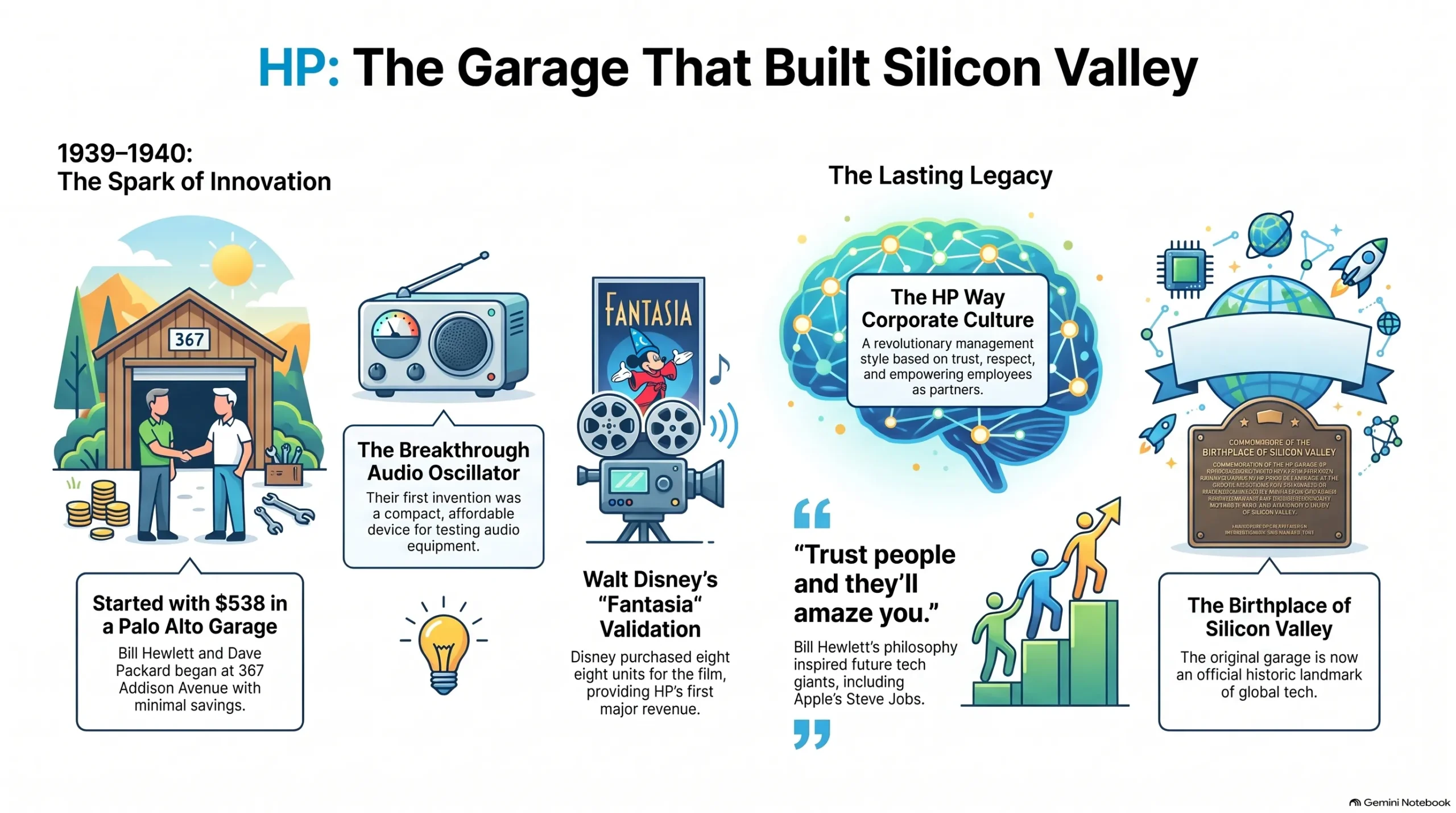
The First Spark
Both men were Stanford graduates struggling to find stable work during America’s Great Depression.
Rather than looking for jobs, they chose to create their own.
Their first invention was an audio oscillator, a simple yet powerful device used by sound engineers to test audio equipment.
At the time, such machines were bulky and expensive.
The HP version, however, was compact, affordable, and precise — an idea ahead of its time.
Their breakthrough came when Walt Disney Studios purchased eight units for the production of Fantasia (1940).
That order became HP’s first real revenue — and their first validation.
Hewlett-Packard (HP): Key Growth & Historical Milestones
| Metric / Milestone | HP Details |
|---|---|
| Founders | Bill Hewlett & Dave Packard |
| Initial Capital & Origin | $538 in savings and no investors; started in a small garage at 367 Addison Avenue, Palo Alto |
| First Invention | Compact, precise, and affordable audio oscillator |
| Breakthrough Deal | Walt Disney Studios purchased 8 units for the movie Fantasia (1940) |
| Company Naming | Order of names decided by a coin toss (“Hewlett-Packard”) |
| Company Evolution | Precision instruments in the 1940s–1950s, expanding into computing and electronics in the 1960s |
| Corporate Culture | “The HP Way” (focused on trust, respect, employee empowerment, and partnership) |
| Historical Legacy | Recognized as “The Birthplace of Silicon Valley” |
From Garage to Global
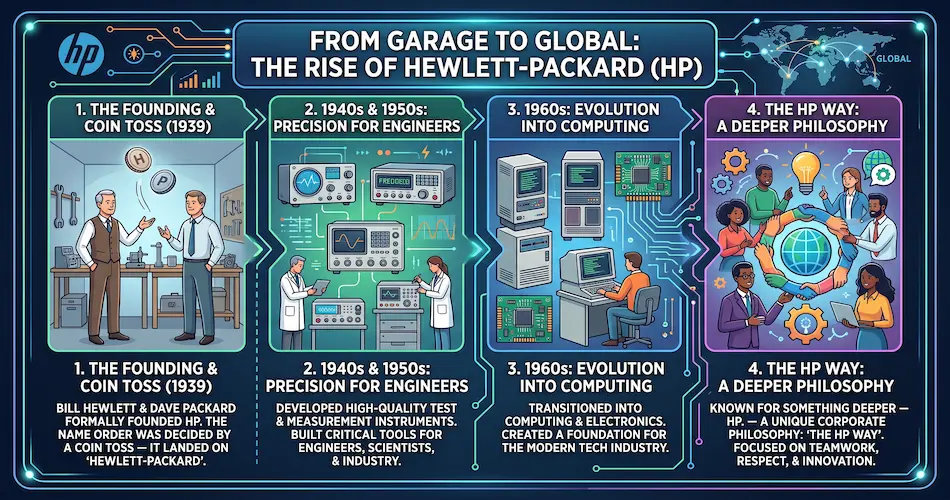
With that success, they formally founded Hewlett-Packard (HP).
The name order was decided by a coin toss — it landed on “Hewlett-Packard,” and history was written.
Through the 1940s and 1950s, HP built precision instruments for engineers.
By the 1960s, the company had evolved into computing and electronics, creating a foundation for the modern tech industry.
But beyond its products, HP was known for something deeper — a philosophy.
The HP Way
HP introduced a corporate culture that was revolutionary at the time: The HP Way.
It emphasized trust, respect, and empowerment.
Employees were treated not as subordinates but as partners in innovation.
Bill Hewlett once said:
“If you trust people and give them tools to grow, they’ll amaze you with what they achieve.”
This mindset inspired generations of entrepreneurs — including Steve Jobs, who often cited HP as a model for Apple’s early culture.
The Symbol of Silicon Valley

Today, the small garage at 367 Addison Avenue stands as a historic landmark: The Birthplace of Silicon Valley.
From that modest space, two friends built a company that helped define modern computing.
💡 Inspiration
No dream is too small when it’s powered by belief and collaboration.
HP’s story reminds us that every great revolution starts with curiosity, friendship, and faith in what’s possible.
💬 Sometimes all you need is a friend, a garage, and a little courage to begin.
📚 Sources:
“4 Gigantic Companies That Started From Nothing” – American Express Business
“The HP Story” – Stanford Archives
“Bill & Dave: The Founders of Silicon Valley” – Tech History Journal
Conclusion
From its humble beginnings in a Palo Alto garage, Hewlett-Packard evolved into a global technology powerhouse that fundamentally shaped modern computing and electronics. Beyond its pioneering products, HP’s most enduring legacy is deeply rooted in its revolutionary corporate philosophy known as “The HP Way.” This progressive management style prioritized trust, respect, and employee empowerment, serving as a blueprint for future tech entrepreneurs and laying the cultural groundwork for companies across Silicon Valley.
Today, the historic garage at 367 Addison Avenue stands globally recognized as the “Birthplace of Silicon Valley,” serving as a lasting monument to the power of curiosity and collaboration. HP’s remarkable journey from a modest $538 savings investment to an industry titan demonstrates that with a strong vision, genuine partnership, and a steadfast commitment to innovation, even the smallest startup can transform the technological landscape.
Frequently Asked Questions about Hewlett-Packard (HP)
How was Hewlett-Packard (HP) founded?
HP was founded by Stanford graduates Bill Hewlett and Dave Packard in a small garage in Palo Alto with just $538 in savings during the Great Depression.
What was HP’s first product and breakthrough deal?
HP’s first product was an affordable audio oscillator. Their breakthrough came when Walt Disney Studios purchased eight units for the production of the 1940 film Fantasia.
How was the name “Hewlett-Packard” decided?
The order of the founders’ names was decided by a coin toss, which landed on “Hewlett-Packard”.
What was “The HP Way” corporate philosophy?
The HP Way was a revolutionary corporate culture based on trust, respect, and employee empowerment, treating workers as partners in innovation.
Why is the HP garage called the “Birthplace of Silicon Valley”?
Located at 367 Addison Avenue in Palo Alto, the garage is a historic landmark marking the birthplace of modern computing and startup culture.