
Red Bull’s journey from a niche Austrian energy drink to a multi-billion dollar global lifestyle brand is arguably the most successful case study in non-traditional marketing. By pivoting away from conventional advertising, Red Bull positioned itself as a media and content house, fueling its growth through high-octane extreme sports, cultural events, and professional athletic sponsorships. This strategic transformation turned a simple beverage into a symbol of performance and endurance, effectively creating a “cult-like” following that redefined the global energy drink industry.
Introduction
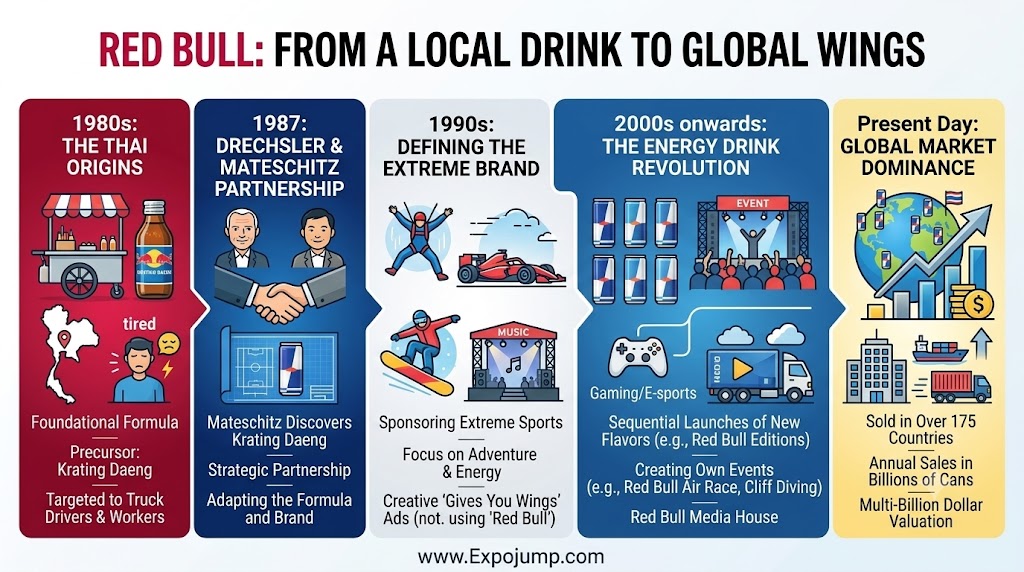
In the early 1980s, Austrian entrepreneur Dietrich Mateschitz was exhausted after a long flight to Thailand.
A local colleague handed him a small bottle of Krating Daeng, a sweet, caffeinated drink popular among truck drivers.
He drank it — and within minutes, he felt revitalized.
At that exact moment, a thought struck him:
“If this works here, why couldn’t it work in Europe?”
That was the beginning of Red Bull.
A Partnership of Vision
Mateschitz met Chaleo Yoovidhya, the Thai creator of Krating Daeng.
Together, they reformulated the drink for Western tastes: less sweetness, a slimmer can, and a name that would resonate globally — Red Bull.
The logo of two red bulls charging beneath a golden sun came directly from the original Thai design.
In 1987, the first cans of Red Bull were sold in Austria.
But convincing the market wasn’t easy.
Authorities questioned the caffeine levels, and consumers had no idea what an “energy drink” even was.
Marketing on the Edge
Instead of traditional advertising, Mateschitz chose a radical strategy.
He built a culture, not a campaign.
He targeted young people who lived on adrenaline — extreme sports athletes, night owls, students, and creative professionals.
The brand became visible at skydiving competitions, snowboarding events, and Formula 1 tracks.
Everywhere energy and risk existed, Red Bull appeared.
By the mid-1990s, Red Bull had transformed from a strange Asian import into a European phenomenon.
Its slogan, “Red Bull gives you wings,” became a global symbol of freedom and motion.
Beyond the Drink
Red Bull wasn’t just selling caffeine — it was selling courage.
In 2004, the company entered Formula 1, later winning multiple world championships.
Then came Red Bull Media House, producing films, music, and extreme sports content watched by millions.
The pinnacle came in 2012, when Felix Baumgartner — supported by Red Bull — jumped from the edge of space.
It was one of the most-watched events in internet history, perfectly representing the brand’s fearless spirit.
The Philosophy
Mateschitz often said:
“We don’t sell a drink. We sell energy, attitude, and a way of life.”
That philosophy made Red Bull not just a product, but a movement — one that celebrates ambition, motion, and breaking limits.
Inspiration
Big ideas are born when you dare to see the ordinary differently.
What starts as a local idea can become global — if powered by belief and boldness.
💬 Red Bull teaches us that sometimes, all you need is faith… and a can of courage.
Frequently Asked Questions
How did Red Bull originally start?
Red Bull’s story began in the early 1980s when Austrian entrepreneur Dietrich Mateschitz traveled to Thailand and discovered Krating Daeng, a sweet, caffeinated drink popular among local workers and truck drivers. He partnered with its creator, Chaleo Yoovidhya, to adapt the formula for Western tastes, leading to the launch of Red Bull in Austria in 1987.
Why is Red Bull considered a pioneer in non-traditional marketing?
Instead of relying on conventional advertising campaigns, Red Bull built its brand around a lifestyle of adrenaline and extreme performance. The company sponsored extreme sports, created high-energy cultural events, and targeted young thrill-seekers, effectively shifting its identity from a simple beverage to a global symbol of courage and motion.
What does the famous slogan “Red Bull gives you wings” mean?
The slogan “Red Bull gives you wings” was created to embody the brand’s philosophy of providing energy, boosting endurance, and empowering individuals to push past their limits. It symbolizes the freedom, ambition, and fearlessness that Red Bull promotes through its association with extreme sports and human achievement.
How is Red Bull involved in extreme sports and media?
Red Bull positioned itself as a media and content powerhouse, moving beyond just sponsorships. They entered Formula 1 in 2004, launched the Red Bull Media House to produce action-sports films, and organized historic global stunts, such as Felix Baumgartner’s famous freefall jump from the edge of space in 2012.
What is the deeper philosophy behind the Red Bull brand?
According to co-founder Dietrich Mateschitz, Red Bull is not just about selling an energy drink; it’s about selling “energy, attitude, and a way of life.” The brand focuses on celebrating ambition and inspiring people to break boundaries, turning consumers into a loyal, cult-like following that connects with this fearless mindset.
Sources:
“Famous Brands Origin Stories” – Looka Blog
“How Red Bull Built a Global Brand” – Business Insider
“The Story of Red Bull’s Success” – Marketing Week